
Imagine that Geoffrey Chaucer, William Shakespeare, and John Milton had all been alive at the same time. I say “imagine” because it didn’t happen, not because it couldn’t have. Yet it did happen, more or less, in eighth-century China, poetry flourishing under the Tang dynasty to such a spectacular extent that the three undisputed masters of the art – Wang Wei, Li Po, and Du Fu – were born within a single thirteen-year span. Various theories have been floated to account for such an unlikely convergence of excellence, but the most fascinating is the fact that, under Tang rule, the composition of verse adopted a professional purpose in addition to its artistic one: namely, those who wished to work for the government – and there was no better employer – secured their place in the hierarchy through the completion of a national civil service exam, no small part of which tested one’s ability to write poems.
That one could not get by professionally without this capacity makes the observation that Wang Wei, Li Po, and Du Fu all held government posts seem a foregone conclusion. But not everyone who could write poems went in for government gigs. Some fled as far as possible from the very suggestion. In Hanshan’s case, the ideal destination was a dark cave carved into the side of a cold mountain.
That’s what “Hanshan” means: cold mountain. In a suitably ironic turn, it’s proved an ideal pen name for the Tang-era poet whose monumental persistence belies the purported childlike silliness of his personality. Like Shakespeare, Hanshan’s identity – including the troublesome question of whether he existed at all – remains the subject of much scholarly debate. At the same time (also like Shakespeare), most of the poems traditionally attributed to his name remain uncontested masterpieces.
Hanshan didn’t tend to write things down on paper (being a cave-dwelling vagabond will do that to you). Instead, his poems had a knack for turning up on tree trunks and rocks. It’s said that a government official by the name of Luqiu Yin is the man we have to thank for the preservation of all that disparately scrawled charcoal. Whether it’s true or not won’t matter for most readers; what counts is the poetry. And yet the substance of that legend – the story behind the poetry – may be just as worthy of your attention. So Mori Ogai believed. This early modernist may be known for a million other things in his native Japan, but his retelling of that legend, “Hanshan and Shide,” is an inimitably satisfying historical fiction, one that depicts the monk-poet – a “skinny, shabby, small” man, wearing “a hat of bark, his feet in wooden clogs” – loitering by a warm stove, ready to laugh at his superiors.
Hiroaki Sato’s decision to include this story front and center in his new translation of a selection of Hanshan’s poems is telling. Not only does Cold Mountain Zen notably do without the snooze-fest of a self-indulgent scholar’s overlong introduction (a page and a half of “Translator’s Note” agreeably orient the reader instead), it unfussily fills that space with other pieces of revelatory prose, such as the “original” account by Luqiu Yin himself (who might also be the invention of an imaginative scribe) and a brief fantasy by Rynosuke Akutagawa, whose narrator (typically Akutagawan) seems to hallucinate Hanshan and his sidekick, Shide, walking the paved streets of twentieth-century Tokyo in an appropriately bedraggled state.
It’s astonishing that readers of English had to wait until 1941, when the estimable Sinologist Arthur Waley finally got his hands on him, to meet Hanshan. Other translations followed, but none moved mountains the way poet/environmentalist Gary Snyder’s did. It was an indirect operation, but the mountains moved regardless – Snyder’s Buddhist leanings penetrating the counterculture of the 1960s by way of Jack Kerouac’s slightly fictionalized account of their ascetic wanderings in The Dharma Bums, perhaps the first and only novel to be dedicated to Hanshan.
It isn’t hard, regarding the poems themselves, to improve on Waley’s effectively unpoetic line, but it would be difficult to judge whether Sato’s translations outmaneuver Snyder’s, or Burton Watson’s, or David Hinton’s. What they do offer – all forty-one of them – are new spins on poems that some of our greatest scholars and poets have deemed worthy of their attention, time, and effort.
Hanshan worked a single form to perfection, all but a small handful of the poems coming out to single stanzas of eight lines each. So far as we know, he affixed no titles to his individual works, and Sato does the same. No titles means no way to find individual poems in the table of contents, which would be acceptable if the book offered an index of first lines. It doesn’t, which is slightly annoying for the slightly fastidious reader. Yet Hanshan himself would have embraced this niggling bit of disorganization. The intuitive cosmology of Zen Buddhism, which tells us that permanence is an illusion, all but commands it.
Yesterday I saw a tree by a river –
it was crushed beyond belief.
There were a few fragments of the trunk,
with countless hatchet scars.
Frost had stripped the leaves of yellow,
waves stabbing its withered roots.
This is what happens to what’s alive –
there’s no point in hating the Universe.
Nature was intuitive for Hanshan, which may be why, in any given poem, plants and animals are never far off.
My house sits under green boulders;
the garden is wild but I do not cut grass.
New wisterias hang down, entwiningly;
old stones stand, rising steeply, sharply.
Monkeys pick mountain berries;
in the pond a white heron mouths fish.
The transcendental book, in two volumes,
I read under a tree, mumbling.
Other people intrude to the extent that their absence occasionally registers a lonesome note on that cold mountain (“In this rustic house, month to avoid heat, / with whom shall I enjoy this bottle of sake?”), but Hanshan appears remarkably content lounging on his “stone couch,” minding the swamp outside, watching the deer and the tigers, and reading – lots of reading. The two volumes of that “transcendental book”? A welcome bit of running commentary accompanies the poem to instruct us: “Maybe Lao Tzu. The line can also be translated as ‘Transcendental books, the pair of them.’ In that case, the books may refer to the Yellow Emperor and Lao Tzu.”
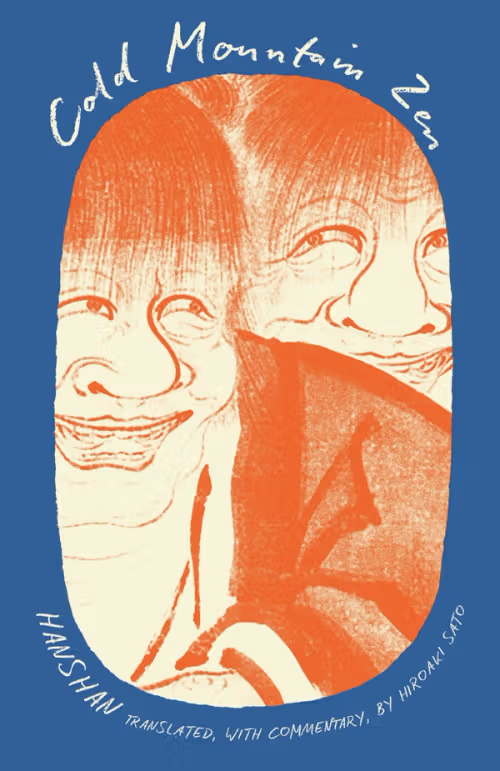
Reading Hanshan in Sato’s expert translation is a testament to being careful but not overly cautious, meditative but not narrowly cloistered. Old paintings of the poet depict a rough-and-tumble eccentric whose carefree smile would seem to have a score to settle with art history, and his poems are modern in exactly the same way: they obliterate the lurking notion that the people of the remote past differed much at all from the people of the present.
People nowadays look at Cold Mountain,
and all say, He’s nothing but deranged.
My face has nothing to attract people’s eyes,
my body is draped in nothing but rags.
My words are things others do not understand,
others’ words are things I do not say.
For all this I say to those people on the street:
Just rise and come face to face with Cold Mountain.
It’s difficult to imagine a finer invitation to the immersive, contemplative world these poems inhabit. Here’s a must-read poet in a must-have edition. Don’t miss it.
Eric Bies is the founding editor of Orange County Review of Books. His essays and reviews have appeared in World Literature Today, Asymptote, and American Book Review, among others.