
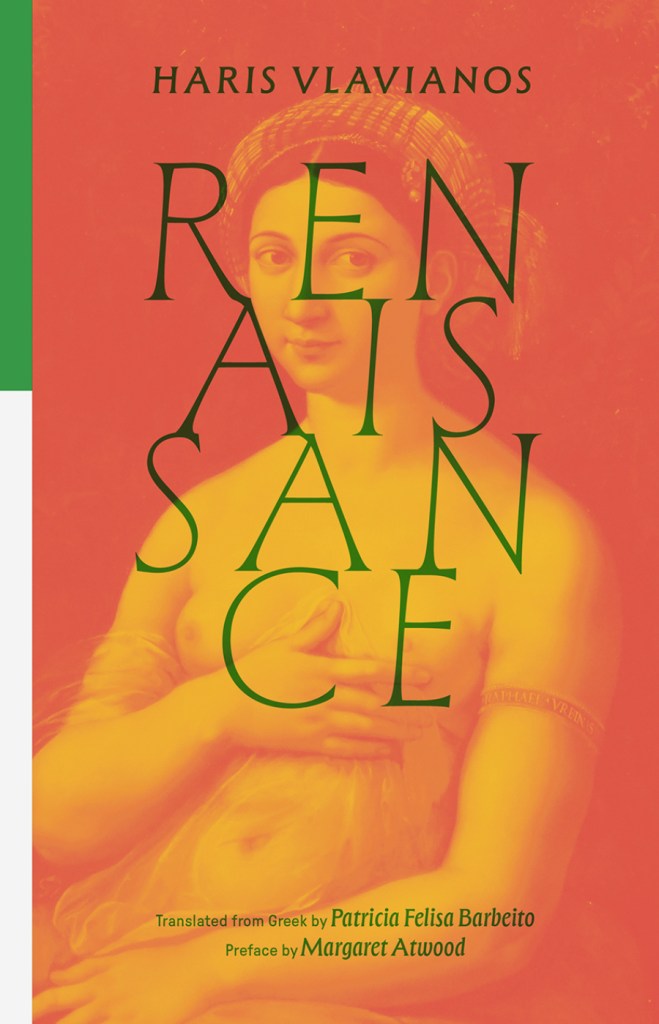
The thirty-six poems that make up Haris Vlavianos’ Renaissance are more than poems, and the book they amount to is more than a book. It’s a gallery, and the portraits that adorn its walls partake in a tradition of secular biography that traces its origins to the Renaissance itself. From Erasmus and Dürer to da Vinci and Montaigne, each piece spotlights a single, radiant figure from the period, and it’s a real boon to the collection’s appeal that its author decided to defy the modern historian’s allegiance to veracity. (He is a poet, after all.) Tending toward the sensational, these poems gratify the hot-blooded reader’s appetite for anecdote, rumor, and scandal, marshalling all the toothsome detail (not infrequently invented) that a well-placed gossip like Giorgio Vasari could muster. In fact, six of the poems spring directly from the latter’s Lives of the Artists – as witness this nimble paraphrase of an encounter between the master, Giotto, and a papal courtier tasked with determining whether the painter’s “talents were equal to their reputation.”
Unfailingly gracious, Giotto
sprang into action.
He took a large sheet of paper,
dipped his brush in red paint,
pinned his upper arm firmly to his side
to serve as a compass
and in a single sweep
drew a perfect circle of breathtaking precision.
Bowing to the courtier, he declared,
“Here is the drawing you requested.”
Alarmed, the courtier replied:
“Am I to have nothing else from you?”
“This will suffice,” answered Giotto.
Similarly absorbing scenes, featuring the antics of sculptors, poets, philosophers, and kingmakers, are the norm in Renaissance. While other poems swerve to more recent times, plumbing the poet’s personal experience in a manner that often reveals some fruitful overlap between his biography and those of his subjects, it scarcely matters whether the one or the other takes the stage; the same energetic, shrewdly lineated blank verse predominates on virtually every page.
In a memorable entry on Benvenuto Cellini, Vlavianos recounts his first encounter with the infamous polymath’s Perseus.
When I first set eyes on it
I must have been six years old.
Ugo, my Italian stepfather,
turned and said to me with a chuckle:
“It’s his head Perseus ought to be holding,
not the Medusa’s.”
“Whose?” I asked.
He didn’t respond.
The poem proceeds to assimilate an unofficial CV of Cellini (“sodomite, murderer / thief, loanshark, extortionist”), samples of the man’s “madman” credentials (“Who else would summon / in the darkness of night at the Colosseum / a ‘legion of demons / to track down his lover, / whose mother / had turned her into a ghost / to deliver her from his grasp’”), and a news story about a museum thief who couldn’t sleep after committing his crime: Cellini “threatened to cut off his tongue / if he failed to return” the stolen property, so he promptly did just that. Does it go without saying that contemporary poetry is rarely so engrossing?
There are poems that do their minimal part to parse the era’s tangled chronology of short-lived popes, poems that briefly revive a few of the bigger names of which you’ve probably never heard (that of Federico da Montefeltro, for one, whose bridgeless nose will forever certify the barbarity of jousting), poems that promote the study of feminine brilliance at a time when the very phrase was an oxymoron, poems that enact ekphrastic excursions into the two-dimensional depths of portraits in oils, and various demonstrations of Vlavianos’ golden sense of humor (with wit and pith and Boccaccian bawdiness to spare). Then there’s the blunt tongue of a fifteenth-century mother bemoaning the hassle of finding the “right wife” for each of her sons:
“There are countless young women
ready for marriage in the city,
but some are ugly with long faces and bad skin”
(you kept a discreet eye on them, even at mass)
while others are “beautiful but wanting in dowry.”
The challenge: to “find a suitable match
with no resemblance to second-rate merchandise”!
That’s Alessandra Strozzi – Filippo the Elder’s financially savvy ma, whose “seventy-three letters […] still extant / reveal almost everything / about the political and social life of Florence.” She does a marvelous job, too, of making you think this poem, which bears her name, is about her. But it’s not – not entirely. The poet has to have his say.
Conversely, I possess
three hundred and six letters
from my mother
(written during the eighteen months
of her confinement in Lyon)
dotted with the word “suicide”
on almost every other page.

Her dilemma
was how to save herself,
even if it meant destroying me and my sister.

To this day, I cannot say
who exactly you were.
You died alone
without either of your children there
to hold your hand
as you slipped away.
This narratively dexterous book may end on that perfectly disorienting note, but the last thing you will want to do is slip from its orbit. Its very slimness – eighty pages of Greek facing eighty of English – recommends an immediate course of rereading, and not just to indulge anew in its several spectacles of debauchery and folly, all those louder forms of humanity (and inhumanity). No, Renaissance is more than just a romp through its namesake. It’s a work of inspired ventriloquism and scholarly collation, a hopscotch of snapshots and confessions, a thoughtfully balanced alloy many careful anvil-clangs in the making. Both fun and profound, this is world poetry at its perennial best.
Eric Bies is the founding editor of Orange County Review of Books. His essays and reviews have appeared in World Literature Today, Asymptote, and American Book Review, among others.
 Orange County Review of Books