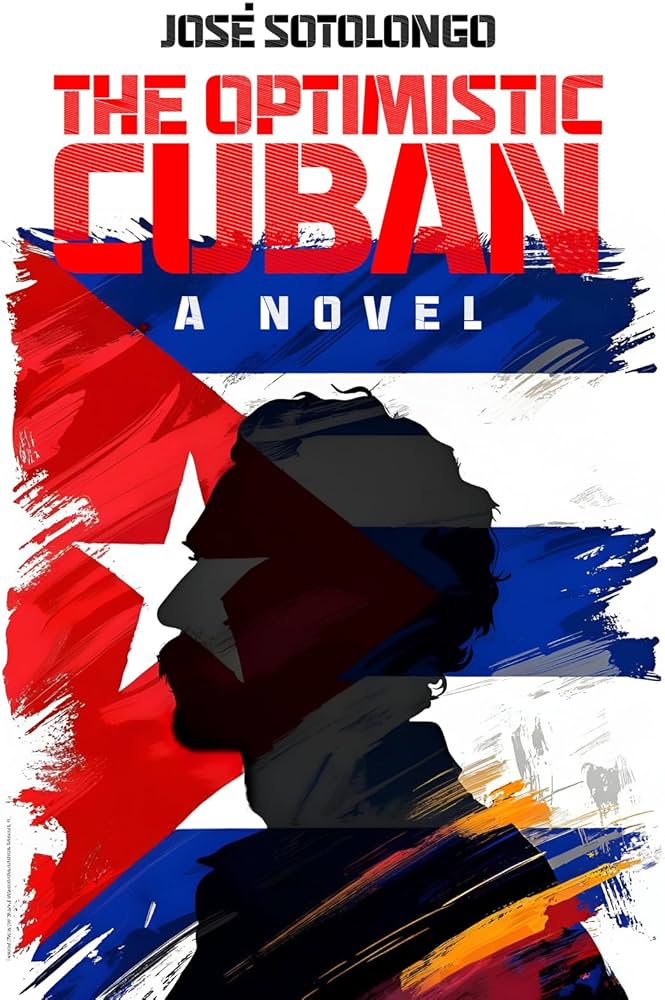
What do you know about Cuba? If you were born and raised in the United States, the compound answer to that singular, finger-wagging question is probably a smattering of factoids pertaining to the Spanish-American War, or just about anything that happened after Fidel Castro’s rise to power. If you’ve read little on the Cuba of Batista – that’s Fulgencio Batista y Zaldívar, who served as presidente from 1940 to 1944, then as a full-fledged dictator from 1952 to 1959 – you could do worse than by starting with José Sotolongo’s new historical novel, The Optimistic Cuban. Though the book fails to nail every one of its historical details, it hits the mark more often than not, and offers an honest assessment of Batista’s Cuba – an assessment that is frankly underrepresented by many Cuban exiles themselves.
Indeed, many of the older members of that group – old enough to remember life before Castro – tend to speak of their homeland as the type of place where the mosquitoes never bite. But the grand mural of Cuban history has always been understood, especially by North Americans, in nostalgic, often mythic terms. José Sotolongo’s role as author of The Optimistic Cuban is, in large part, to smash every pair of rose-tinted glasses in sight. Irony is his specialty, and one target after another falls before his expert thwacks: not just the difficulties in Cuba under Batista’s fascist dictatorial reign writ large, but the specifics of political violence, political suppression, infidelity, racial discrimination, wealth disparity, corruption, American corporate opportunism, and the desire of many Cubans to flee the island even before Castro lit the powder keg of revolution. It’s easy to look back over the ruts and grooves of Cuban history and apply a simple set of paints to a simple depiction of Castro as the villain he is, but Sotolongo takes the difficult route, through fiction no less, of complicating that narrative by highlighting the context in which Castro came to power.
The Optimistic Cuban really hits its stride when its characters open their mouths: its hyper-realistic dialogue eschews the stylization that usually lifts readers from the filmlike dream of a scene as it unfolds in real time, and the result is a series of fictional conversations that feel as though they are happening right in front of you. And where are you? In 1950s Cuba. The novel implicitly (and at times explicitly) centers on the very Cuban question of family – to what extent it matters, who gets to be a part of yours, and the concomitant tensions between freedom and security.
This is a book about leaders, not just leaders of nations but also leaders of households, of movements, of futures, of relationships. Rather than centering on the “leaders” of Cuba, Sotolongo’s narrative explores how ordinary people find themselves leading amid the manifold uncertainties of their lives – the uncertainties brought on by the baffling leadership styles of Batista and Castro.
If there’s anything to learn from this novel – and education isn’t usually among the top reasons for reading one – it’s that revolutions offer individual experiences just as readily as they offer social ones. It’s common to construe revolutions as monolithic mass movements, but they tend to form deeply personal experiences; and, tragically, the individuals involved, those who experienced and were a part of profound political forces, must somehow assume a sense of normalcy in its wake. The villainy of a regime may offer what seem sound temptations to revolution, but there is a great cost to pay when radicalism leads to authoritarianism. This novel faithfully and vividly charts that arc’s fiery course.
Anthony David Vernon is an adjunct professor of philosophy at St. Thomas University (Miami Gardens) and Miami-Dade College.
 Orange County Review of Books