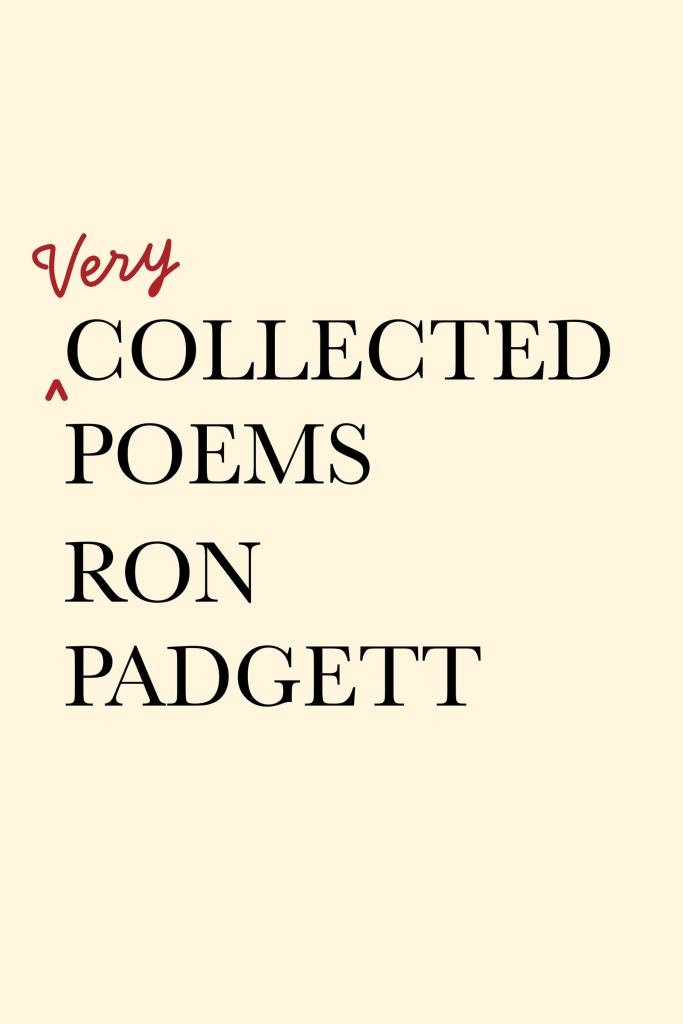
Ron Padgett’s been busy. In the dozen years since the publication of his Collected Poems, America’s silliest living poet has been the author of five additional books of poetry, a celebrated translation of Apollinaire, and a memoir of the dead poet Dick Gallup. It’s a remarkable output for a decade and change, but even more remarkable is the oxymoron of the old poet behind it all – no hair, no guitar, no gutter bravado – just the poet growing poems in the shadow of his tombstone. Remember Keats? Remember Rimbaud? Remember Dylan Thomas, whose 39 years seem somehow far too many? Padgett is, incredibly, 83, and he shows no signs of slowing down. So mark your calendars. Sometime in the back half of the 2030s we’ll have a Very, Very Collected Poems to praise.
Most of that praise will be nothing new, of course, the current consensus having been many years in the making. John Ashbery and Charles Simic found it easy to champion Padgett’s work, but so too do the few remaining lay readers of contemporary American verse – and not because he made mazes, chessboards, or cryptograms of his stanzas. Padgett’s poems rarely puzzle (though they do occasionally razzle-dazzle). Neither elusive nor obtusely simplistic, their unstated mission is as noble as it is probably destined to fail – restoring poetry to its proper place as the most widely appreciated literary genre. The angle of the poet’s approach? “Duh … I … uh …,” he writes in his “Ode to Stupidity”:
I bet you never heard of Huntz Hall!
Huntz, he was a heck of a guy!
He had two eyes, in his head!
And a mouth, under them!
And some other stuff, like you know
Ears and stuff, but the best
Was his brains, boy did that guy
Have brains!
Before you laugh – but wait; you’re allowed to laugh. Really, you’re encouraged to giggle as the cartoon image of Huntz Hall (what a name!) comes together in your two-eyed head. There’s nothing Padgett seems quite so serious about than the care with which he conveys his lack of seriousness. Which isn’t to say his approach to writing a poem is in any way a reproach to order. On the contrary, much of what makes this collection worth reading at all is its debt to tradition. Most of the time, Padgett’s lines slide free of the expectation to march or to rhyme, but the steadfastness of his style and delivery still manages to make him look a little suspect to readers and writers of an experimental persuasion. One truth about the history of literature is that the most vital poems have never had to choose between marshaling images or advancing an argument; they’ve always done both, in thoughtful concert. It’s the often odd, somewhat paradoxical quality of the register Padgett occupies in doing so – playful yet sensible, curious yet restrained – that makes him such an anomalous source of, well, fun. Confident in his clowning, he’s in control every step of the way.
And he’s been in control. The collection’s first poem, “Wind,” appeared when Padgett was just 22. But its opening lines are dutifully poetic –
Now it is over and everyone knew it
The bad grass surrendered in unison and with much emotion
The long-awaited became despised
Everyone got tired and concluded that phase
– in an entirely different manner than the book’s last poem, “Inside,” which readers of Padgett’s penultimate collection, Dot, encountered just a couple of years ago (his latest, Pink Dust, might have come too late to make the cut):
Notebook, you,
my friend,
are running out of pages.
It’s time to say good-bye
to you, leaving a few blanks
at the end
for you to rest in.
For me there is no rest,
just more words
somewhere else,
my portable prison,
my life sentence
without parole,
surrounded by puns.
It was the fate of Sisyphus to shoulder a boulder uphill forever, and it’s Padgett’s lot, apparently, to do the same: no rest, just more words. No surprise then that a kind of hyper-awareness about one’s vocation, the life of a poet, doesn’t only turn up here, at the end, but everywhere. Straddling the book’s fifteen-page Index of Titles – which runs from “Absolutely Huge and Incredible Injustice in the World, The” to “Zot” – this reader counts not just eleven odes (to God, Horace, Mussolini, and Uncle Edgar, among others) but fifteen different poems identically titled “Poem.” An early one runs away from itself:
I’m in the house.
It’s nice out: warm
sun on cold snow.
First day of spring
or last of winter.
My legs run down
the stairs and out
the door, my top
half here typing
The poem bisects itself repeatedly until there’s nothing left but the poet’s dogged fingers (a few lines further might have figured half a finger, then a nail, then nothing) – a poem charting its own disappearance. No other poem in the English language reads quite so much like a real-time demonstration of Zeno’s famous paradox about the tortoise and Achilles – the poem going, so it seems, somewhere, but never quite getting anywhere. It’s emblematic of Padgett’s enterprise (if sixty years of poetizing can be summed up in that single, soul-effacing word) to be both there and not there, both here and half here, with one foot out the door.
At more than 1,100 pages in length, Very Collected Poems is the proverbial kitchen sink, and its arrival this holiday season is bound to scare any number of slimmer sheaves of poetry into the shadows. Good riddance! Real fans of poetry deserve such monuments – in this case, the work of a lengthy lifetime: decades of wondering and pondering, deadpan ironizing and making meaning in America, just the kind of work that must never have felt like work at all. How could it have for the poet for whom the living of life is like loitering with intent? “You are next in line,” Padgett writes (in a poem titled “Method”), and that makes life exciting: “every moment is another line / you’re next in. / Or maybe not, for what about when / you don’t know what ‘line’ is and ‘next’?”
Eric Bies is the founding editor of Orange County Review of Books. His essays and reviews have appeared in World Literature Today, Asymptote, and American Book Review, among others.
 Orange County Review of Books