
Death is a kind of cleaving; it separates and binds. Case in point: Sylvia Plath left her children behind when she gassed herself in her London flat, but she also laid the groundwork for a future union with Anne Sexton, who died a decade later huffing the same chemical compound. Ryunosuke Akutagawa and Stefan Zweig both OD’d on the same barbiturate, just as Virginia Woolf and Hart Crane leapt identically into rushing waters. Then there were those two notable pieces of Parisian roadkill.
The accidents happened on different streets, of course, and at the hands of different drivers, but it’s a striking bit of serendipity that links one of the twentieth century’s most provocative theorists to one of its most quietly persistent poets. Roland Barthes’ cachet is such that even drug-addled art-world toadies can rattle off the title of Camera Lucida, but if Jean Follain’s name fails to ring any bells it’s probably because his body of work has largely eluded English translation. The periodic efforts, for instance, of W. S. Merwin (1968) and Heather McHugh (1981) have made no real splashes to speak of. That’s dozens, no, hundreds of poems worth reading that have yet to be read – a travesty, and yet…
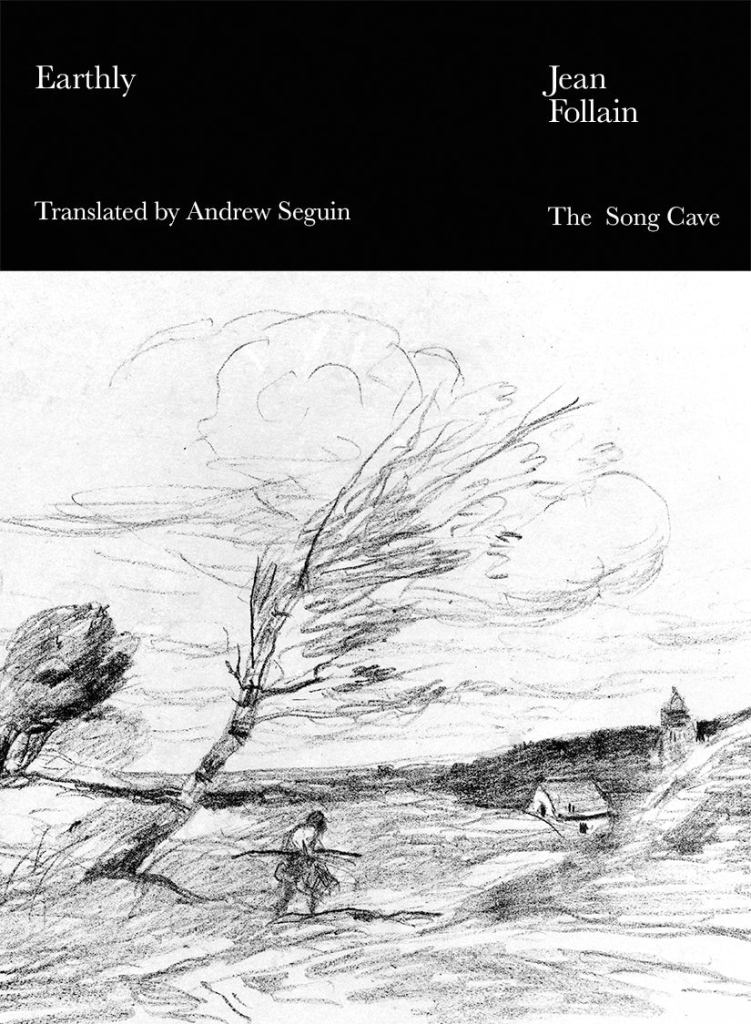
Enter Andrew Seguin, whose new book of translations, Earthly, is the first English-language collection to range over the entirety of Follain’s career. It was a long career – the poetical parts carved from the rinds of long days working, like so many other working poets, as an attorney – and it’s a fitting title: There’s nothing in Follain that smacks of the spectral or abstract, nothing that verges on the unearthly. While the poems tend to favor concrete images (building up tidy cairns of them), their simplicity is something of a deception. On virtually every page emerge physical presences which, imminent, singular, impossible to dismiss, end up commanding a kind of glacial attention. Consider an early poem, “Shadows and Gleams”:
In the leafy shade of an enclosure
an entire world feeds
and the officer returns
with his uniform covered in black braids
a lobed leaf
trembles in the north wind
gripping the wooden table
with a square hand
a man goes on
surrounded by his bees
but the woman
crumbles flaky bread
for a circle of blessed birds.
Before the poem’s fifth line can unfurl the hidden association between a tree’s leaf and the lobe-like projections of the poem itself, the reader must first assimilate many leaves, the shade they make, a frenzy of feeding (one that is felt if not seen), and a man in a dark uniform. Gradually a kind of Franciscan vision begins to cohere: less frenzied than you’d think, a congregation of birds has gathered to enjoy their version of the Eucharist (the woman at whose feet they peck – more naked, descriptively, than Eve – is literally breaking bread). But then there’s the matter of the aforementioned officer and that beekeeper with a hand composed of right angles. Or is it the lobed leaf’s hand that grips the wooden table, stabilizing itself in the wind?
These are just a few of the fruits of Follain’s rather unique approach to writing a poem. A good deal of which generally boils down to a taste for ambiguity. A particular knack for ambiguous enjambment showed up early in the poet’s work – the merest hint at its later stature as a stylistic hallmark. But when meaning gets to swerve and pivot in the controlled environment of a poem the way it does here, poetry becomes – Follain’s poems become – the de facto medium for rereading.
In addition to a brief introduction (in which Seguin asserts that Follain “sounds like no one else. His phrasing, his syntax, his curious punctuation, seem to take the mind out like a dog, let it sniff a post, before arriving somewhere unexpected”), the book marshalls the poet’s output into three major sections: early work from 1933 to 1953, a dose of prose poems from 1957, and further poems spanning 1960 to 1971, the year Follain died. The earlier pieces demonstrate a degree of ambition that has little to do with length (nothing here exceeds a standard page in length) and everything to do with volubility. It feels somewhat natural, then, that the later works should grow increasingly laconic, more concerned with what’s underfoot. In “Deep in the Back,” Follain writes
of the vast attic
where rats feed on poisoned wheat
a ray of sun lights up the enormous pile of gazettes
out of which comes the musty odor
of a faded century
in the sky soon every light will go out.
Poetry, in Follain’s hands, is hardly the standard vehicle for introspection. Go looking for an “I” in these pages and you will be gone looking for some time. You’re liable, along the way, to bump into a scarecrow or a dog, or to tip over a glass of cider. The closest thing to that “I” may be the single punctuation mark that shows up at the end of every poem, a period at the bottom, a fingerprint for a style that is generally parsimonious with such devices: the poet saying, “I was here!”
It’s as a prose-poet that Follain seems least himself – or, rather, too much himself, a saturation of himself. It’s sticky stuff that fills the book’s slim central section – its pileup of images betraying the essential richness of the poet’s materials (which, it turns out, are best enjoyed sparingly). A leaner prose writer working a similar seam is Monsieur Giono, and Follain’s attempts at sounding like the other Jean will only leave you hankering for Hill, The Horseman on the Roof, or, hell, Melville.
But what Earthly lacks in one brief span of pages it exhibits, in spades, just about everywhere else. Here is a poet whose sympathies toward the peasantry recall the humanism of Montaigne, and whose silent, watchful animals remember Eden. Poet of children, poet of windows, poet of black ants and flowers, Jean Follain is, simply, a poet you must not miss.
Eric Bies is the founding editor of Orange County Review of Books. His essays and reviews have appeared in World Literature Today, Asymptote, and American Book Review, among others.
 Orange County Review of Books