
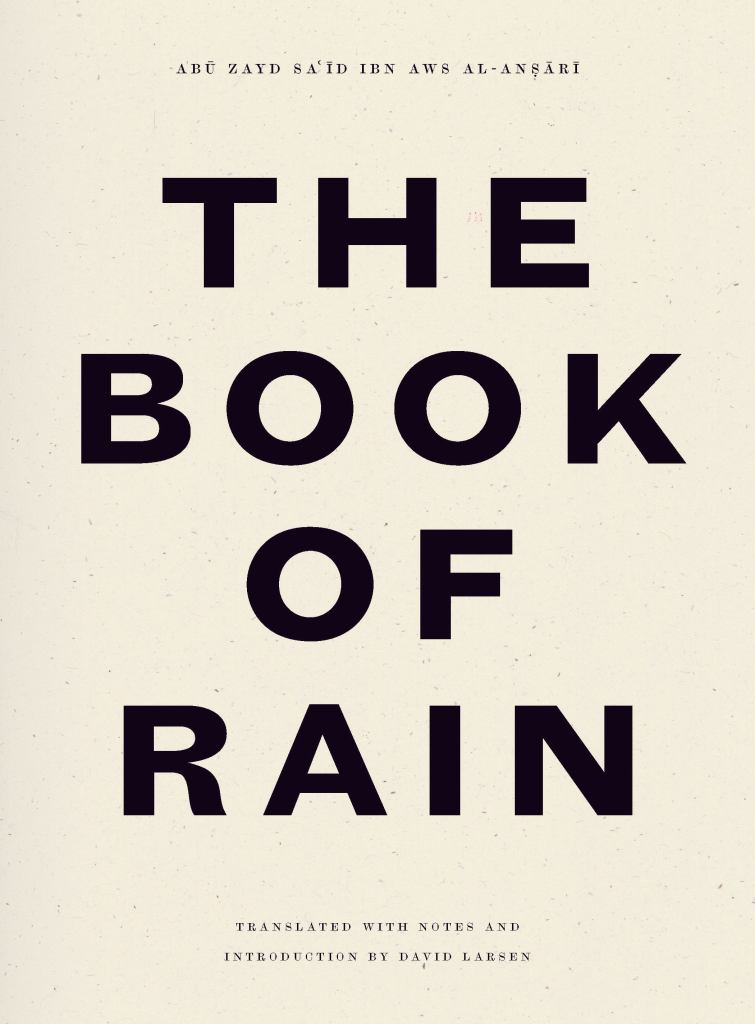
David Larsen is an expert translator of premodern Arabic texts. In 2017 Wave Books published his translation of Names of the Lion, tenth-century grammarian Ibn Khālawayh’s catalogue of lion-names. To read that book is to tumble beneath a stampede of epithets (“The Mangler,” “The Hateful,” “The Tyrant”), consider a slew of leonine modalities (“Who Eats Until he’s Sick of Food,” “Who Is in No Peril after Dark”), and try on a series of glittering raiments (“Whose Coat Is the Color of Dawn”), among other inventive constructions. Now comes The Book of Rain (also from Wave), Larsen’s magnificently thorough rendering of an obscure archive of Arabic weather-words. One of just a few surviving works by the ninth-century lexicographer Abū Zayd Al-Anṣāri, The Book of Rain might appear to be little more than a list – little more indeed than the kind of cobwebbed corner a specialist cleans up for other specialists to enjoy – but Larsen’s version is more than all that. For starters, it’s remarkably modern. In the same way that Sei Shōnagon’s Pillow-Book baffles coordinates in spacetime, Abū Zayd’s Rain-Book reads like it could have been written yesterday, its author less a scholar than an accidental poet, which is to say a kind of lightning rod.
It doesn’t matter, either, that Abū Zayd wasn’t shooting for poetry; Larsen found it, and fashioned an apparatus worthy of Charles Kinbote to present it. The book’s preponderance of front- and backmatter serves to demystify Abū Zayd’s laconism, so many words about so many words transmitted across so many centuries, sandwiching the Islamic scholar’s twenty-six-page reference work between a forty-one-page introduction, thirty-five pages of endnotes (in Larsen’s lion-book it was strictly footnotes that made a high fence of the lower margin of most pages), a sixteen-page appendix (on “The Names of the Wind”), and fourteen more of sources. Larsen is a poet in his own right (with the modern poet’s taste for typologies), but, like Abū Zayd, he’s a scholar first. Unlike the noted translator of Omar Khayyam, Edward FitzGerald – whom Borges considered merely lucky, maybe metempsychotically inspired, a dilettante who probably hadn’t a clue what he was doing – about Larsen there’s nothing that’s enigmatic. He’s clearly studied the building down to the studs. “Right away,” he writes in his introduction,
it should be acknowledged that the Book of Rain is not a definitive list. More exhaustive catalogues of Arabic weather-words are out there, as for example Kitāb al-Azmina wa-l-amkina (The Book of Seasons and Places) of al-Marzūqī (d. 421/1030). The Book of Rain’s distinction is that it is the earliest known to have been made.
For Abū Zayd’s contemporaries the book initiated a lexicographical tradition of sifting and sorting, one that reached backward to the first and fullest springtime of Arabic poetry to do so, but the tradition that plucked its petals proved to be short-lived: the flowers of those earliest Arabic poets have outlasted most of the systematizing works they inspired. Larsen’s role in the history of these texts, then, is partly resuscitative. His translation clears the way for a kind of encounter that may be just as rare today for English readers as it is for Arabic ones.
And he may be a scholar first, but Larsen’s presence on the page is never solely scholarly, never merely strenuous. He’s companionable, even funny, with an eye for the kind of radiant detail that makes the dustiest corner of the historical record feel permanently pertinent. Of Abū Zayd specifically – whose renown was such that “‘Abū Zayd said’ is a refrain throughout dictionaries that are still in regular use” – by the end of a long, long life, “we are told that his memory failed him, but not his good humor.”
It was then that al-Riyāshī approached Abū Zayd with a manuscript copy of the Book of Trees and Herbage, in order that his aged teacher might authenticate its contents. “May I read it out to you?” he asked. “Don’t bother,” said Abū Zayd. “I’ve already forgotten it.”
Unlike attested works on goats, camels, sheep, human anatomy, and Arabic dialects, we remember the Book of Rain largely because its manuscript survives, its very existence justifying its continuing existence. The terms it preserves are sprinkled philosophically, ranging across categories which, if not always touching it directly, orbit the central subject of rain (“Names of Rain”). These include “Asterisms and Seasons,” “Frosts and Dew,” “Dust Clouds,” “Names of Thunder,” “Names of Lightning,” and “Names of Clouds.” The book begins with the refrain, “Abū Zayd said,” and this is what he said:
The tribesmen of Qaysi say: First of the rains is al-wasmī “The Mark-Maker.” Its asterisms are al-ʿArquwatān al-Muʾakhkharatān min al-Dalw “The Latter Bucket-Timbers” [αβ Pegasi], then al-Sharaṭ “The Fore-Runner” [βγ Arietis] and then al-Thurayyā “The Pleiades.” These constellations are separated from each other by intervals of some fifteen nights.
Asterisms get their gloss in Larsen’s introduction (they’re essentially junior constellations: think Big Dipper, not Orion). Al-wasmī, we find out in the main text’s first footnote, “gets its name from wasm, which is a ‘brand’ for marking livestock. This name is for the rain that marks bare ground with vegetative growth.” It’s a start, but what else can Abū Zayd teach us? Perhaps that rain really is so much more than its various watery manifestations? Expectations be damned: In a Book of Rain, half the fun’s in running up against so many meteorological contiguities. (Larsen’s intro begins with the observation that “[t]he course of a day is so permeated by its weather that the presence or absence of clouds is a natural synecdoche for all the day might hold.”) The book oozes with occasions for the reader’s inner natural scientist to emerge. Like T. S. Eliot who gave voice to the thunder (like Joyce who coined a hundred-letter word to rumble in its place), Abū Zayd’s attention to the words that mirror our world and its weather remind us, finally, that there is a world out there, and it’s wrapped up in all manner of weather. Consider that the phrases “Al-takashshuf ‘Full Disclosure’ and al-istiṭāra ‘The Outspreading’ are said of lightning whose illumination fills the sky,” or that “al-fary ‘The Lengthwise Split’ is for the brilliance of the lightning as it hangs in the sky.” Elsewhere, Larsen records “the best description of lightning in all of Arabic poetry”:
Awash with blood the view to the west was,
horizons red with the sun’s blotting,
and lights blared out and vanished into tinsel –
reiterative flame, its newness never dulled
by repetition.
Who knew that language could light up the page like this?
And though Abū Zayd’s phrases are constantly shifting, tracking patterns of rainfall, dust storms, and more, shuttling from light into darkness and back (but sometimes not so quickly), Larsen’s flashlight reliably illuminates every difficult passage. Most of us aren’t up for the titanic undertaking of learning to read Arabic. Larsen’s performance, like a fish in water, will make you want to. Or, at the very least, it will have you marveling at the strange and beautiful fruit of a culture distant both in time and sentiment. At the tail end of such a prodigious effort (it isn’t rare for a single endnote to spread its erudition across two or more pages), you’re liable to breathe the same sigh, or a shadow of the same sigh, that Larsen breathed when he completed the book. Abū Zayd’s book ends with a prayer: “God be praised for His blessing, and prayers be upon His Prophet, our master Muḥammad.” To which we can add: David Larsen be praised for this glorious book.
Eric Bies is the founding editor of Orange County Review of Books. His essays and reviews have appeared in World Literature Today, Asymptote, and American Book Review, among others.
 Orange County Review of Books