
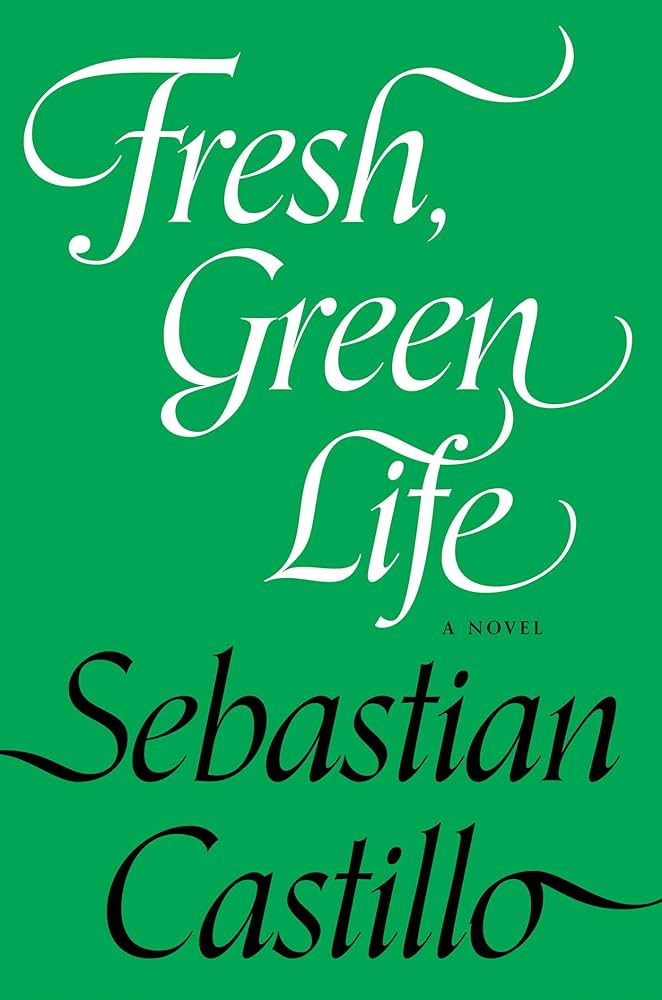
I ordered Sebastian Castillo’s Fresh, Green Life after a writer friend whose taste I respect texted me the recommendation and I skimmed a sample online that looked good and noted “South Philadelphia” in the author’s bio and “Thomas Bernhard” in Publisher’s Weekly and Kirkus reviews. For thirteen years after moving there from the Midwest after getting an MFA in fiction, I had lived in South Philadelphia in a $495/month third-floor studio apartment on Tenth Street overlooking the dueling cheesesteakeries, my first year in Philly adjuncting at Temple, earning a total of $15K for four Creative Writing and English Lit classes over two semesters, ultimately losing my shit after one year adjuncting in Philly and leaving academia for good.
I had read nearly everything by Bernhard in translation by then, written rants about my first year in Philadelphia in the style of Bernhard, and a few years later I translated a short novel the El Salvadorean writer Horacio Castellanos Moya had written in imitation of the style of Thomas Bernhard. Fast forward a decade or two, I live fifteen miles west of Philadelphia where the bookstores aren’t all that plentiful, so if I want to buy a novel like Fresh, Green Life from a small press (Soft Skull), even one distributed by a massive NYC conglomerate (Penguin Random House), I have to order it, which I did. Once Fresh, Green Life arrived, I removed it from the mailer and, as I walked up the driveway from the mailbox, I looked at the author photo on the back cover and unreservedly exclaimed “ha, what a douche!” But I assure you it wasn’t a mean-spirited exclamation. The author was clearly up to something with his turtleneck and tweed jacket, and I was down for it.
When I returned inside with this new book, wife was on the couch laughing at an Instagram post about how no one ever recognizes the most famous player on the Dolphins. She showed me the picture and I laughed and said “amazing,” not because I recognized Ray Finkle from “Ace Ventura: Pet Detective.” I showed her the back cover of Fresh, Green Life, how author resembled fictional football player, and hilarity ensued in our household.

So that’s how my reading of the novel began, with this ridiculous LOL convergence. And here’s how it ended: the primary Philadelphia subway lines run north-south and east-west along Broad Street and Market Street. If you live south of South Street and you get off Regional Rail at Suburban Station in Center City, if you took the subway after 1 am on New Year’s Eve after a party in the northern suburbs, you would take the Broad Street Line south a few stops and then walk east. Or continue on Regional Rail to Jefferson Station and then head south on foot from 12th and Market. But then if you had some money in your pocket, maybe you’d just take a cab home? Or maybe take the Market Steet Line east to 2nd and Market and then walk south through Society Hill, depending where you lived in South Philly?
But the way Sebastián Castillo, the narrator of Sebastian Castillo’s Fresh, Green Life, heads home at the end of novel seemed a little off to me in a way that synched with two other things that had also seemed off earlier in the novel: 1) the bartender at Dirty Frank’s called the SPCA on a dog that wandered in (super-dubious that a Dirty Frank’s bartender would do that unless the dog were attacking customers), and 2) the narrator referred to The El Bar as “up north” when it’s three blocks north of Girard, to the northeast (of Dirty Frank’s) or simply east, more or less, of City Hall, whereas “up north” suggests maybe Brewerytown or somewhere “up” near Temple.
Taken together, all this seemed more than just nit-picky on a location level. It seemed maybe fundamental to an underlying theme of the novel: a sly variation on the fine art of faking it until you make it. The city itself seemed real yet just a little off, that is, fake real, more like its double than itself?
Anyway, Fresh, Green Life is organized into two somewhat stylistically divergent sections, the first is mostly exposition, summarized backstory setting up the mostly dramatized second section. The focus is on a New Year’s Eve party to which the narrator, now thirty five, is invited as well as a few former student friends, including Maria, a becoming former crush, recently divorced from her normie husband with the unlikely name, Andrei Rublev. The narrator builds expectation for the party and its host, a professor at his alma mater, an experimental liberal arts college in Montgomery County, just outside the city, not far from where lovely Maria grew up in Bala Cynwyd. It doesn’t seem based on actual colleges in the area like Haverford, Bryn Mawr, Villanova, or Rosemont. Regardless, Professor Aleister is intriguing as a risqué, somewhat touched professor of philosophy remembered for holding forth and inviting valued students to his home for informal drinks and talk.
That’s the setup, as well as a bit revealed toward the end of the first section that the narrator has spent the preceding year working on his physique after a heart-related health scare, not teaching, living in silence in a $600 basement apartment (in Bella Vista or Queen Village maybe). There had been a pretty serious precipitating incident: he’d smashed his teeth, as one often does as an overworked adjunct, after delivering a lecture on leprechauns to a business-writing class.
But that’s just the setup. The star of the show is the prose: elevated slightly, affected somewhat, generally influenced by literature in translation from a century ago but liable at times to lapse a little into contemporary colloquialisms, the resultant amalgam in register predominately kicking some ass, particularly when about contemporary concerns such as social media and the manospheric YouTube scene:
There were videos featuring health personages who had advice as to how much protein or carbohydrates one should consume, and there were also videos of men who claimed that taking very brief, cold showers improved them, and other videos that said that eating only according to the dictums of a limited, typically meat-centered diet was the key to one’s salvation, while there were others who forbade self-gratification, yet more who said that taking rather small doses of certain psychoactive drugs could help one move beyond the stultifying sleepwalking of contemporary life. And in the comments to all these videos were several young men who claimed their lives were saved because they no longer ate bread, or no longer came to pornography, or no longer cooked eggs in vegetable oils, but in butter: a whole ecosystem of young men who said that they had been saved, very thankfully saved, because they took the advice a man in a video had given them. And the men in the videos were very convincing! And they would, indeed, compete with one another for their salvic purchase in the minds of these many young supplicating men: for example, when I began committing myself to health exercises, I realized early on I required direction for which kinds of exercises to perform, how many, for what duration, and so on. To my surprise, there existed an entire cottage industry of videos made expressly for this purpose.
The prose style is fun, but it’s not really Bernhardian, is it? Thanks to reviews I’d skimmed I had expected something more Bernhardian. There’s one line about his health scare that’s repeated three or four times nearly verbatim, but, to my mind, for a novel to earn the term Bernhardian the prose style needs to be ratcheted up from a two to at least eight or nine on the Bernhard dial, and it should really be all one paragraph and without conventional dialogue. That is, the prose style must be more exaggerated, relaying repetitive ranting in an orchestrated yet organic stream of long sentences, and in particular these long repetitive exaggerated sentences, tweaked to nine on the dial controlling prose style, must be presented in a single paragraph throughout the book, or at least throughout a long section, with certain key phrases serving as buoys in the whitewater of the exaggerated repetitions, the certain key phrases serving almost as space breaks in the ceaseless exaggerated orchestrated yet organic churning around the axle of thought, grinding of gears of language all the while, after which the focus of the ranting might modulate but the form continues in a ceaseless display of sheets of exaggeratedly repetitive ranting prose.
The prose style in Castillo’s novel is far less exaggerated, but you can sense the influence of old-timey French and German prose in translation in there, sure, the inversions of syntax, the perfectly stilted word choice, the inclusion of “indeed.” All of which is good clean fun, albeit not quite Bernhardian, a page of prose of which looks like this (a random photo of page 59, chosen randomly from Old Masters, side by side with page 59 from Fresh, Green Life for comparison’s sake):
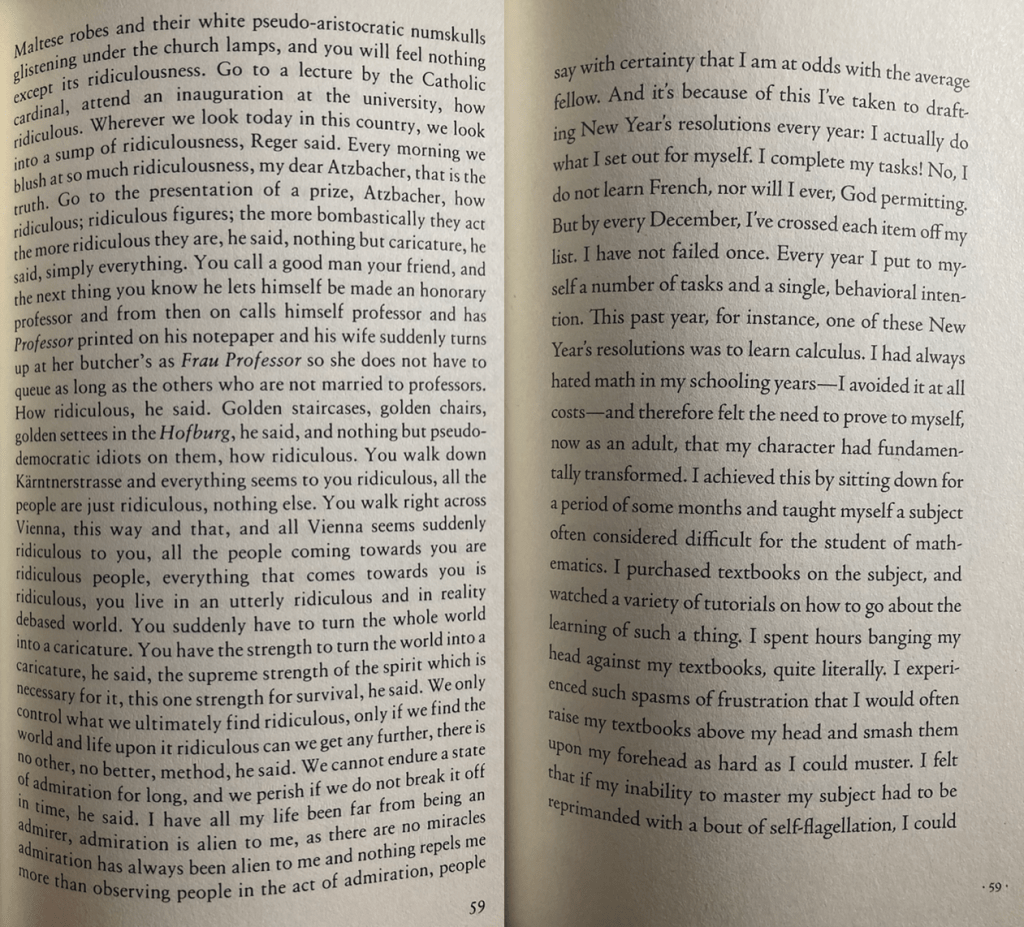
The above photo on the right of page 59 from the Castillo novel isn’t quite representative of the whole, since the second section is more dramatized, often presented in a dialogue with the professor, for example this thematically significant paragraph:
Math is fake, but at least math is more real-fake than philosophy, which is fake-fake. Even the total failures of literature – pharmacy-store paperbacks, amateur work of the poorest caliber – even these examples are more fake-real than the most sublime work of philosophy, which is always fake-fake. I’ve dedicated my life to boring nonsense, it seems, I would say, when I should have dedicated my life to delicious nonsense.
The overall theme relayed by the title, and explicated in an author’s note at the end, of a “natural” life uncapturable by philosophy, which is fully fake, or even literature, which is half-fake (“fake-real”), is nearly Bernhardian in its idealism, the idea of trying to bridge the gap separating actual lived experience from intuitive art /rational philosophy being a worthwhile struggle.
Bernhard is a frustrated idealist more than a simple “misanthrope,” as his narrators are usually labeled. He rants against nearly everything because everything falls short of his lofty ideals. The narrator of Fresh, Green Life has more or less gone mad but he’s not quite a raging idealist. Unlike Bernhard, the general cast of Fresh, Green Life is more satirical and ironic, and also unlike Bernhard, it’s loaded with reference to canonical philosophers and high-lit writers, and related quotation. But, like Bernhard, there’s an accretive effect after a while, a build-up released as amusement if not quite an out-loud laugh. There’s something about these references, for example about Deleuze, Derrida, and Lacan, that are simply fun to read, and that also make you feel kinda smart, but are ultimately, when you take a second to consider them, maybe just empty references?
Which isn’t a negative critique of the novel at all.
Recognition of the omnipresence of empty reference, I believe, may be one of the novel’s points, or one of its jokes, or at least seemed fundamental to my enjoyment of the book by the end. When the narrator accosted a kid for reading Jordan Peterson, for thinking guys like him have it all figured out because they make their beds first thing in the morning and have otherwise read Peterson and watched his stupid videos, it struck me reading that climactic scene that the same is true for readers whose eyes cross the names of famous respected canonical and/or obscure and possibly concocted writers and philosophers referenced throughout the novel. Readers feel smart for reading a novel streaked with lightly stylized, semi-archaic exposition (apparently considered Bernhardian) about how, for example, the narrator had attended classes on Balzac that had hardly mentioned Balzac at all. That is, just because a scene in Proust and Amalfitano’s geometry book from 2666 make an appearance doesn’t necessarily mean that the author has done much more than offer well-regarded literary references to make readers feel smart and thereby please them.
But there’s more to this than just pleasing readers with high-brow reference: artifice of the sort is fundamental to what’s ultimately a real act of artistry. Reminiscent of the “Before the Law” scene at the end of Kafka’s The Trial, the novel ends with a summary of the final scene in “Andrei Rublev,” the gist of which is like the boy crying “wolf wolf” and somehow thanks to sufficient commitment to the bit he creates an honest-to-goodness actual wolf. Fresh, Green Life does something similar, earning its enviable French flaps: the author photo is slyly affected, Philly details may seem slightly off, the prose is slanted/Euro-lit-in-translation enchanted, and the novel’s infused with an elevated number of probably pretty empty philosophical/literary reference calories (“delicious nonsense”), but the overall effect, on this reader at least, was an experience of actual real-real elevation, like the train tracks at Front and Girard where the narrator finds himself in the end. It’s nowhere near his place in South Philly but it’s a few blocks from the El Bar, true north on the compass of the soul.
Lee Klein is the author of Like It Matters and can be found here.
 Orange County Review of Books