
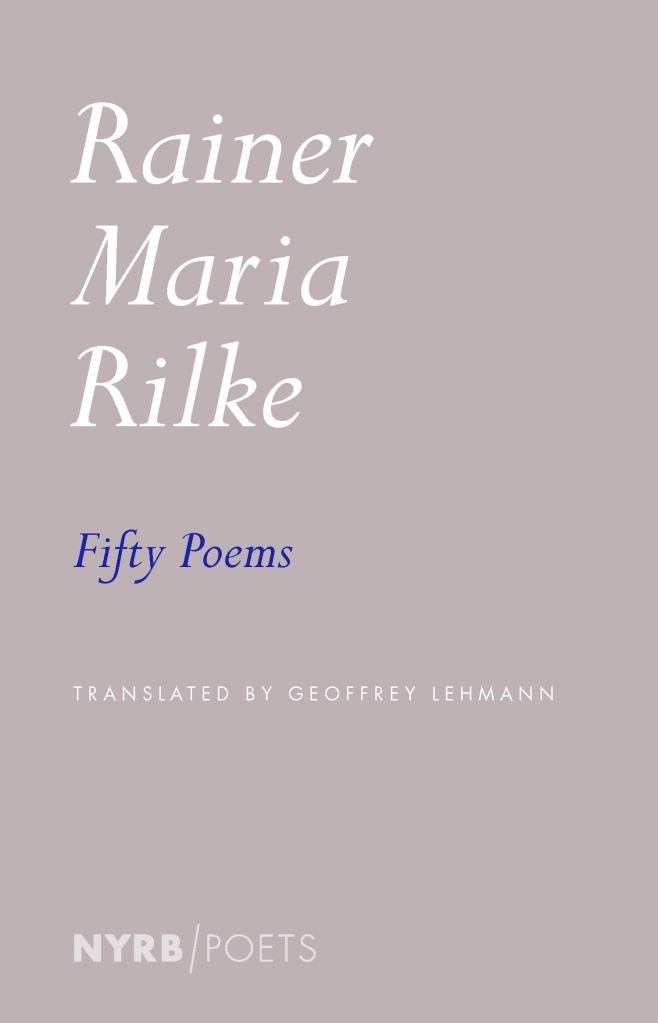
“The poet,” William Gass writes in Reading Rilke, “never forgets a metaphor.” And he’s right; he doesn’t. Open to a random page of R. and you’re liable to see a piano player’s “hand, heavy with its jeweled ring, and slow / as though trudging through drifts of snow / travel across the ivory keys.” Some birdcall ringing through a faded wood? It makes “a sound as round and wide as the sky.”
That isn’t just Rilke, though. It’s Rilke as translated by Australian poet Geoffrey Lehmann, whose English renditions fill out Fifty Poems like subtle clones of the originals. Unlike most translations of Rilke’s work, Lehmann’s versions refuse to dispense with the rhymes that Rilke (prior to the Duino Elegies) found so indispensable. There isn’t a poem among these that doesn’t rhyme – not an easy feat for either author, neither German nor English being languages readily disposed to rhyming. Amazingly, Lehmann also manages to mirror the number of syllables in the master’s lines.
Around they go, this spinning cavalcade
of painted horses, three to every row,
storybook creatures from the afterglow
of a strange country that’s about to fade.
Some hauling carriages, they show no fear,
boldly parading with their small, neat faces
as after them a fierce, red lion paces,
and a white elephant brings up the rear.
Hence the first stanza of “The Carousel.” Here’s the original:
Mit einem Dach und seinem Schatten dreht
sich eine kleine Weile der Bestand
von bunten Pferden, alle aus dem Land,
das lange zögert, eh es untergeht.
Zwar manche sind an Wagen angespannt,
doch alle haben Mut in ihren Mienen;
ein böser roter Löwe geht mit ihnen
und dann und wann ein weißer Elefant.
It’s something of a codebreaker’s delight that inclines a poet like Lehmann – a positivist, for whom no translational task appears beyond attainment – to make a poem look and sound like its original. What reads, however, like the product of a lifelong obsession is actually the result of a retirement’s diversion; as Lehmann writes in his Afterword (“Impersonating Rilke in English”),
By the time I was seventy-eight, I had written all the poems I wanted to write. […] On a whim I translated Rilke’s “The Panther.” More translations followed. Each translation required a few hours of preparation, then next morning I plunged in as though I was writing a poem myself. Rhyme and meter require a concentrated flow. Over the next six years I revised the translations, trimming my extravagances to be closer to the German text.
It’s fitting that “The Panther” kindled Lehmann’s interest in translating Rilke, since it’s the same poem, famously composed in the Jardin des Plantes, that marked Rilke’s transition from an energetic fledgling to the mature poet of “things,” the poet of roses, laurels, and archaic torsos, that is, the poet we recognize as Rilke. (For that we can thank the bearded sculptor Rodin, who one day directed the young poet to exit his studio and go to the zoo.) In a poem that Kafka could have written, Lehmann’s panther moves
Backwards and forwards in the cage, his gaze
is so fatigued there’s nothing it can hold.
For him there are a thousand bars, always
the same bars, and beyond the bars no world.
In a diminutive circle turning there,
the easy padding and the nonchalant stride
are a pure dance about a midpoint where
a great will is arrested, stupefied.
But sometimes the pupil’s shutter flicks up
mutely – . An image entering through the eyes
travels through tense limbs, coming to a stop
in the immobile heart, and dies.
Fifty Poems is poetry-in-translation at its best. Nimble and inventive, Lehmann gives us the rare English Rilke worth preserving immediately.
Eric Bies is the founding editor of Orange County Review of Books. His essays and reviews have appeared in World Literature Today, Asymptote, Open Letters Review, Rain Taxi, and Full Stop, among others.
 Orange County Review of Books