
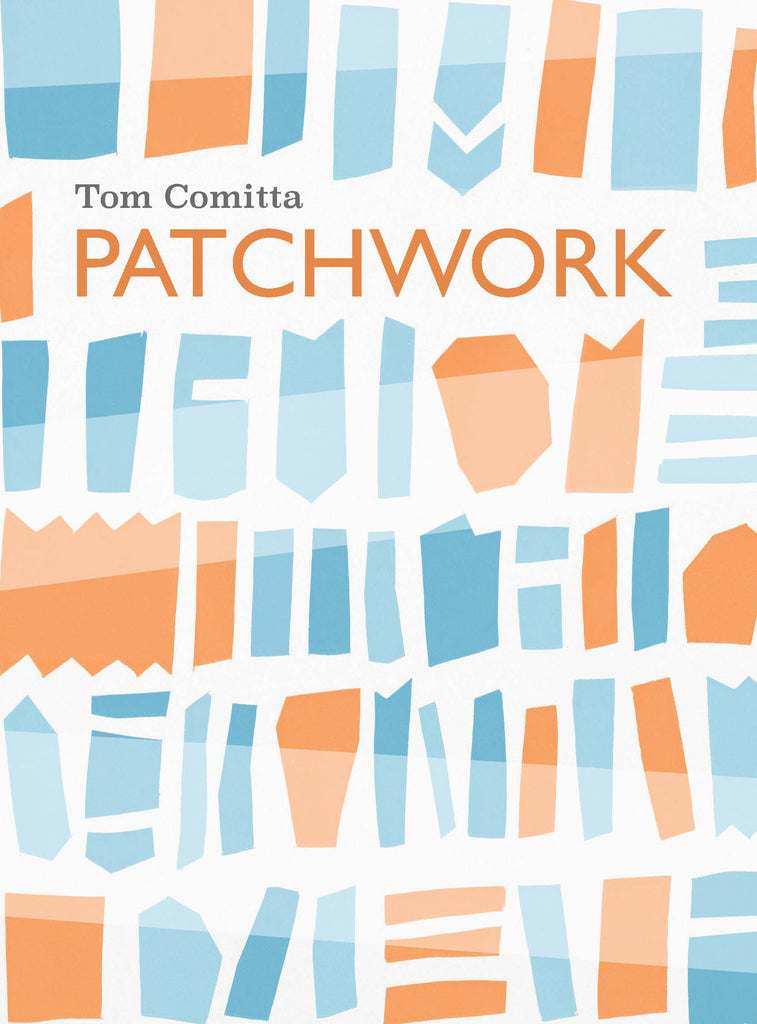
It’s been the trademark of a handful of authors to graft an alien sentence or two among the branches of their own prose. Herman Melville, Guy Davenport, W. G. Sebald, they all did it to different degrees, but no one’s come close to matching the efforts or aims of Tom Comitta, whose latest novel, Patchwork, ventures far beyond this simple notion of grafting. No, Patchwork is exactly what it sounds like, a textual quilt composed entirely of other author’s sentences.
Imagine it: someone hands you a trove of novels, hundreds of them. They’ve been digitized, which helps matters considerably, but you’re still stuck with the problem of picking one sentence over another, of finding their order, their rank. You want to tell a tale, and you have all the sentences to tell it (to tell several of them, in fact, several times over), but which sentence goes first, which sentence next? For Commita, the answer is often the most intuitive one, so that the first chapter of Patchwork consists of the first sentences of other novels. This is how it opens:
Dear Anyone Who Finds This,
If you’re going to read this, don’t bother. If you are interested in stories with happy endings, you would be better off reading some other book. I am a sick man…I am a spiteful man. I have never begun a novel with more misgiving.
That’s Lynda Barry, Chuck Palahniuk, Lemony Snicket, Fyodor Dostoevsky, and W. Somerset Maugham, in that order – a group of writers most readers would never think to lump together. And yet, somehow, it works; they work.
The same is true all throughout Patchwork, which offers, most immediately, a rollicking yarn about a stolen snuffbox. But forgetting the plot for a moment (and Comitta makes it easy for you to put the story aside) most of the novel’s magic lies in its dedication to literary experimentation. There’s a chapter made of descriptions of running and jogging, a chapter that squawks and coos with the raucous sounds of birds, a slew of “MacGuffin collages” (there goes that snuffbox!), even a purely visual chapter that makes a kind of comic strip out of illustrations from the novels of Charles Dickens. Somewhat predictably (but no less deliciously) the final chapter consists of final sentences. An exemplary snippet runs toward
The sea. The earth. The house of the seven gables toward the shore. It was the end of the line. It was the beginning of my present prosperity. It was an adventure. The beginning of an adventure. That was how it felt. So that, in the end, there was no end. This was just the beginning. It was not midnight. It was not raining. Evening began to fall.
It’s persistently fascinating following Comitta’s process, each chapter revealing its own previously undiscerned narrative pattern – how, in this case, a string of staccato lines is capable of lending the book’s ending a kind of sober, uncompromising finality. In fact, so many last lines drawn together make for an ending that assumes the stature of an archetype: the ending of all endings; likewise, before it, the beginning of all beginnings, the quest parceled out between them going places no fiction has gone. For fans of Ulysses, Oulipo, Joseph Cornell, and the like, Patchwork takes textual collage to new heights, and is sure not only to inspire a new generation of writers and artists but to both challenge and satisfy any reader with a hankering for daringly adventurous literature.
Eric Bies is the founding editor of Orange County Review of Books. His essays and reviews have appeared in World Literature Today, Asymptote, Open Letters Review, Rain Taxi, and Full Stop, among others.
 Orange County Review of Books