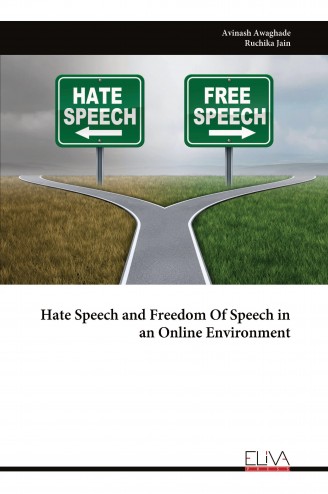
Hate Speech and Freedom of Speech in an Online Environment
By Avinash Awaghade and Ruchika Jain
Eliva Press. 2025.
Reviewed by Anthony David Vernon
Freedom of speech is often thought of as a kind of unshakable pillar, a timeless concept with clearly defined limits, but this is wishful thinking. In Hate Speech and Freedom of Speech in an Online Environment, Avinash Bhagwan Awaghade and Ruchika Jain are quick to point out that, far from being “monolithic,” freedom of speech has actually “evolved across time and across cultures, navigating a treacherous terrain between individual expression and societal cohesion.” Their book, the product of two legal studies scholars, attempts to work out the problem of eliminating hate speech online without infringing on the right to free speech.
It’s too bad then that their scholarship is tainted from the get-go: assumptions regarding the existence of fundamental rights and the inherent nature of hate speech conflict with a real-world understanding of free speech, which tends to work like a fumbled football. Like freedom of speech, both fundamental rights and hate speech are products of social evolution, and one need look no further than the internet for ample demonstrations of all three.
The idea of freedom of speech has not, in the authors’ understanding, “always welcomed diversity of thought.” On the contrary, freedom of speech is often employed as a bludgeon to clear the way for hate speech: “free speech for me but not for thee” is the name of the game for those with an interest in promoting nationalism, gender-based discrimination, student censorship (see the ongoing pro-Palestinian protests on college campuses), and a whole slew of other examples from across the political spectrum. Internet personalities such as Ben Shapiro, Elon Musk, and Nick Adams provide their own glaringly obvious examples of free speech wielded one minute and censorship the next.
Awaghade and Jain are correct to note that the ubiquity of online harassment “serves as a sobering reminder of the ongoing difficulties disadvantaged people confront in the fight against discrimination and hate speech” – that not everyone will “work together in order to bring about significant change and build a society in which everyone is treated equally, respectfully, and with dignity, both online and off.” At the same time, they miss a crucial opportunity to distinguish between kinds of change: changes in mindset via digital literacy and PSAs are one thing; but radical changes to the environments themselves are another. To heighten decorum, to ennoble behavior is simply not enough to diminish hate speech online, especially given the myriad ways in which the internet actually incentivizes the activity of bad faith actors.
Bad faith actors do not care for “initiatives to advance social justice, equality, and human rights as well as to create a more welcoming and peaceful community for all of its members.” Many wish to control speech on the internet as a means to profitability, as is the case with Google, while others seek to control online rhetoric for power, with Justin Trudeau as a leading example. According to Awaghade and Jain (who reference the work of feminist legal scholar Catharine MacKinnon), so-called “‘free speech’ now protects Nazis, Klansmen, and pornographers while doing little to help their victims.” Worse, these bad faith actors are also easily able to profit from their hatred, the worst of their rhetoric often favored by large content-recommendation algorithms, as when Facebook helped push anti-Muslim content in Myanmar.
Hate Speech and Freedom of Speech in an Online Environment is an extremely well-researched text, one that juggles a great deal of complex concepts and systems with ease, such as the Indian legal system. That being said, the book both benefits from and limits itself by centering most of its information in the national contexts of India and America; though the authors do well to stick to what they know best, the book offers very little in the way of how speech occurs on the globalized Web.
The book’s major drawback is in its philosophical considerations. The authors’ common pursuit of social justice for all, and especially those marginalized by society, is not assisted by “the internet’s shroud of pseudo-anonymity.” The internet is rife with anonymous agents, bots, and profit-driven hate speech – and bad faith actors will not be fixed via liberal calls for decorum. If you want to curb hate speech online, you must alter the fabric and incentive structures of the internet itself, as behavior is largely (though not entirely) shaped by the environment. “A shift in social attitudes and norms” won’t do the trick; the internet must be deterritorialized before it can be reterritorialized into a space in which all users benefit, including clear, navigable spaces for marginalized individuals.
All in all, the book is very much worth reading, especially for those with an interest in speech laws. It is packed with just the kind of detailed and useful information to equip readers with an understanding of the legal-speech landscape in the internet age.
Anthony David Vernon is an adjunct professor of philosophy at St. Thomas University (Miami Gardens) and Miami-Dade College.
 Orange County Review of Books