
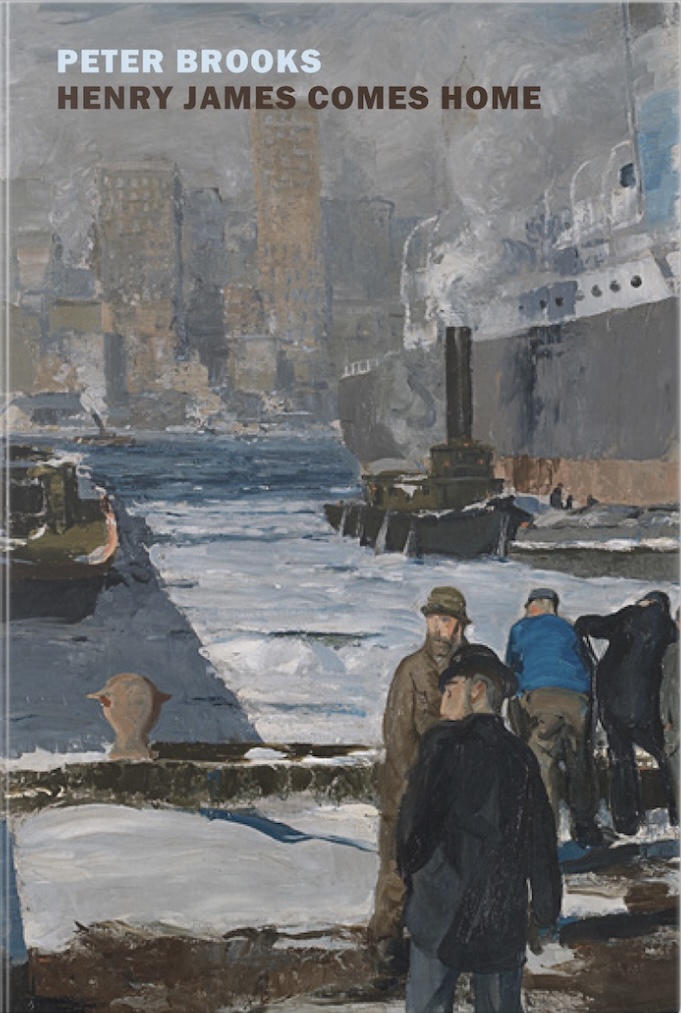
Henry James Comes Home: Rediscovering America in the Gilded Age
By Peter Brooks
New York Review Books. 2025.
Reviewed by Eric Byrd
In Henry James Comes Home Peter Brooks recreates James’s North American tour of 1904–5 and looks into what James “made of what his nation was on its way to becoming.” The American Scene (1907) is what James made of his journey, and in elucidating that singular work – Auden called it “a prose poem of the first order” – Brooks has made a welcome addition to a subgenre one might call the “biographies of books”: critical studies with a narrative sense, lively accounts of how a particular work came to be written. Like Steegmuller’s Flaubert and Madame Bovary and Gorra’s Portrait of a Novel, Henry James Comes Home tells the story of a style and describes the context of creation; like Betz’s Rilke in Paris and Kennan’s Marquis de Custine, it charts a journey, clarifies an itinerary, and identifies the encounters in which a writer’s later reflections are rooted.
In 1903, after nearly three decades in Europe, where he had gone as a “yearning young American,” James felt time had come to return to “the native, the forsaken scene, now passing…through a thousand stages and changes, and offering an iridescence of fresh prospects.” Brother William’s warning of the “physical loathing with which many features of our national life will inspire you” failed to daunt the artist (as opposed to the mere aesthete) into “giving up, chucking away” his chance to treat the experience of return, to convert it, “through observation, imagination and reflection now at their maturity,” into “vivid and solid material, into a general renovation of one’s too monotonized grab-bag.” To Howells he flatly declared, “I am hungry for Material.”
In the “darkened gorges of masonry” of the “huge jagged city,” James sought traces of his old New York. He studied “the conversion of the alien”: “ingurgitation” at Ellis Island – “settled possession” of certain neighborhoods – “promotion” evinced by the straight teeth and the good shoes of the children. Though his younger brothers had been officers in the 54th Massachusetts, James showed no comparable interest in how African-Americans were faring, I think because he saw them as permanent aliens, unassimilable and fit only to serve. He whimpered over
the apparently deep-seated inaptitude of the negro race at large for any alertness of personal service, having been throughout a lively surprise. One had counted, with some eagerness, in moving southward, on the virtual opposite – on finding this deficiency, encountered right and left at the North, beautifully corrected; one had remembered the old Southern tradition, the house alive with the scramble of young darkies for the honour of fetching and carrying…
He pitied the southern gentry as “the people in the world the worst ministered to” and added that he could have “shed tears” when “reflecting that it was for this they had fought and fallen.” A “group of tatterdemalion darkies” at a rail station in Virginia prompted him to advise Northerners that, when considering the “formidable question, which [rises] suddenly like some beast that had sprung from the jungle,” they should remember that “the Southern black” is so repulsive, so “ragged and rudimentary,” as to “disabuse a tactful mind of the urgency of preaching, southward, a sweet reasonableness about him.” More contemptuous of native-born blacks than of European immigrants, James presents the reversed image of General Sherman, who announced, in an 1888 essay published in the North American Review (where seven installments of The American Scene would appear in 1905–6), that he had at last come round to black male suffrage. After all, he wrote, they are Americans, and so more familiar than the “Bohemians who reach Castle Garden by thousands every day of the year.” To further complicate this picture of WASP racism, I’ll add that Sherman would have found James’s sensitivity to the plight of Indians mawkish and soft-hearted.
In Philadelphia James found New York’s opposite, a society consanguineous and calm. Washington, too, offered a contrast, a “City of Conversation” (especially so to a guest of Henry Adams) where, socially, the business man wasn’t the sole category of male. “It took no greater intensity of the South than Baltimore could easily give” for him to feel “the huge shadow of the War,” though in Richmond he at first felt nothing – the drab, sour, Northern-looking city was not “grandly sad,” lacked “a nobleness of ruin,” and did not match his “lurid, fuliginous, vividly tragic” idea of it; but the artist was there to admonish the aesthete, and James discovered that an aborted capital is naturally drab and sour, and quite interesting for that. By Charleston he was reconciled to straining to see historic romance, and he accepted Florida as a primeval blank, “a Nile, in short, without the least little implication of a Sphinx.”
Beneath the aesthete who deplored ugliness, beneath the artist who lamented the lack of associational “thickness” needed for his practice of fiction, there sat, animating both, a patriot of sorts, one brooding over the consequences of careless greed and plutocratic nihilism. For James aesthetic impressionability and novelistic analysis were tools to detect and describe the forces he thought menaced “continuity, responsibility, transmission.” James’s method of detection and description, Brooks writes, was to “latch on to an apparently telling detail” and elaborate “an idea that, under the pressure of his imagination and the work of his prose, develops into a kind of imagistic anthropological vision.” The American Scene has a “figural” texture – James’s “language of analysis, eschewing the statistical and the journalistic, found its greatest truth in a continuously analogical and metaphorical discourse.” James’s advocacy of architectural preservation, dignified urbanity, and the maintenance of public art and amenity carries a stern warning: a society that builds things so oppressive no one becomes attached to them, and demolishes everything before it can begin to get old, will never be anything but “expensively provisional,” barely habitable. The American Scene has plenty to make one wince, but enough of its writing is beautiful, enough of its analysis usable; and Brooks is to be thanked for bringing this complicated book closer to our eyes.
Eric Byrd is a librarian and archivist living in Minneapolis-St Paul, Minnesota.
 Orange County Review of Books