
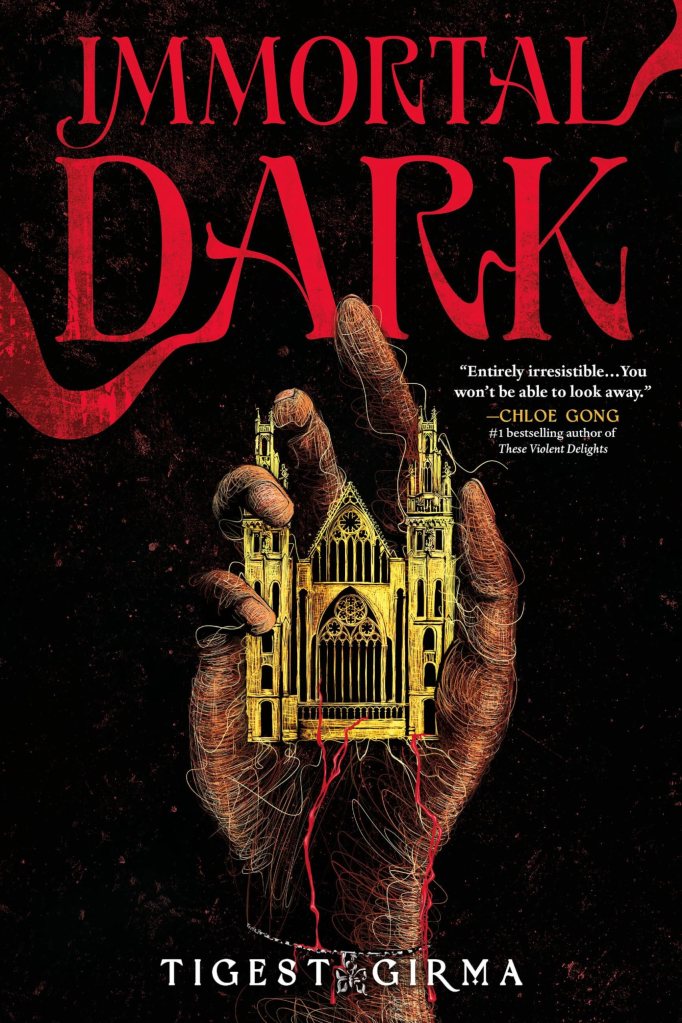
Who knew murder could be the answer to everything?
Manipulation at its finest: how to survive Uxlay University? In her debut novel, Immortal Dark, Tigest Girma pulls no punches in propelling readers into a world where death is both a curse and a means to an end, where betrayal often comes cloaked in bloodlines and tradition.
Set in a supernatural, East African-centric world, Immortal Dark centers on Kidan Adane, a determined young adult searching to uncover the truth behind her twin sister’s eerie disappearance. The novel’s initial conflict arises when Kidan comes to believe that her house’s vampire, Susenyos Sagad, has played a part in causing her sister to vanish. As Kidan navigates the perilous halls of Uxlay University – a school meant to prepare the students of elite families for succession, challenging them to understand their eternal bond with vampires and how they grew to coexist with each other – readers are immersed in the deadly politics of Uxlay’s secret society, a society rooted in heritage, secrets, and the thirst for power.
Immortal Dark dramatizes the lengths that grieving people sometimes go in hopes of finding a semblance of relief. Girma doesn’t pause much during her novel’s worldbuilding phase, which may detract from the story’s ability to fully immerse the reader. Short chapters and sharp shifts between scenes sometimes make it feel like you’re reading a graphic novel, the fragmented narrative reading almost like a storyboard – episodes of emotion, betrayal, and small victories compiled into a larger, layered plot that needs time to unravel. What the book lacks in atmospheric depth, it makes up for in its bold narrative voice and morally ambiguous characters. The presence of vampires, not as outright villains but as embedded, valued members of society despite the danger their existence brings, reinforces the themes of desperation, deception, and survival, thus adding a political flavor reminiscent of caste systems and class hierarchy.
One of Girma’s strongest choices is her incorporation of cultural mythology and symbolism, particularly through the inclusion of Ethiopian artifacts and philosophies in the storyline. A powerful moment occurs when Kidan is forced to endanger a sacred item passed down through her family – an event filled with generational significance and the fear of repeating ancestral mistakes. As we learn more about the history of the Adane house’s vampire, Susenyons Sagad, their connection to a rich cultural heritage serves as the foundation for three tenets that govern vampires once they are bound to a house. These elements provide the novel with a strong cultural base, even though the surrounding fantasy framework is somewhat underdeveloped. The book would have benefited from a more detailed exposition of the setting. While the premise is engaging, readers are often left wanting more information about Uxlay’s rules, the history of the vampires and those that deviate from their closed-off society, along with how the supernatural forces operate within this world in the first place.
In terms of characterization, Kidan is a complex, sometimes frustrating protagonist; her loyalty to her sister, as her last surviving family member, overrides her logic at almost every turn. Her humanity derives from her grief – the grief of a child raised in a world that never offered sufficient time to process complex emotions in the first place. Having to fight for her late family’s inheritance made her sense of morals both irrational and flexible. The antagonists she faces are difficult to dislike, as they are also very layered characters. Girma skillfully balances the roles of villain and victim with nearly every character she introduces, eliciting empathy for each in a manner that few authors manage to do so well.
Overall, Immortal Dark is a fast-paced, emotionally charged novel that invites the reader to reflect on the importance of family, identity, and the dream of freedom, where that freedom is found through trauma, legacy, or mortality. The touching depth with which Girma approaches each character will surely connect the reader with their cause. I recommend this book to lovers of flawed protagonists and the genres of dark academia and Afro-fantasy. The novel would especially appeal to people who appreciate stories that combine deep ties to ancestral identity with a modernized spin through the supernatural.
Immortal Dark might not answer every question it raises, but it offers an audacious narrative steeped in culture, grief, and the cost of truth.
Jana Ford is a rising freshman at the University of California, Los Angeles. She is pursuing a degree in applied mathematics with a focus in finance.
 Orange County Review of Books