
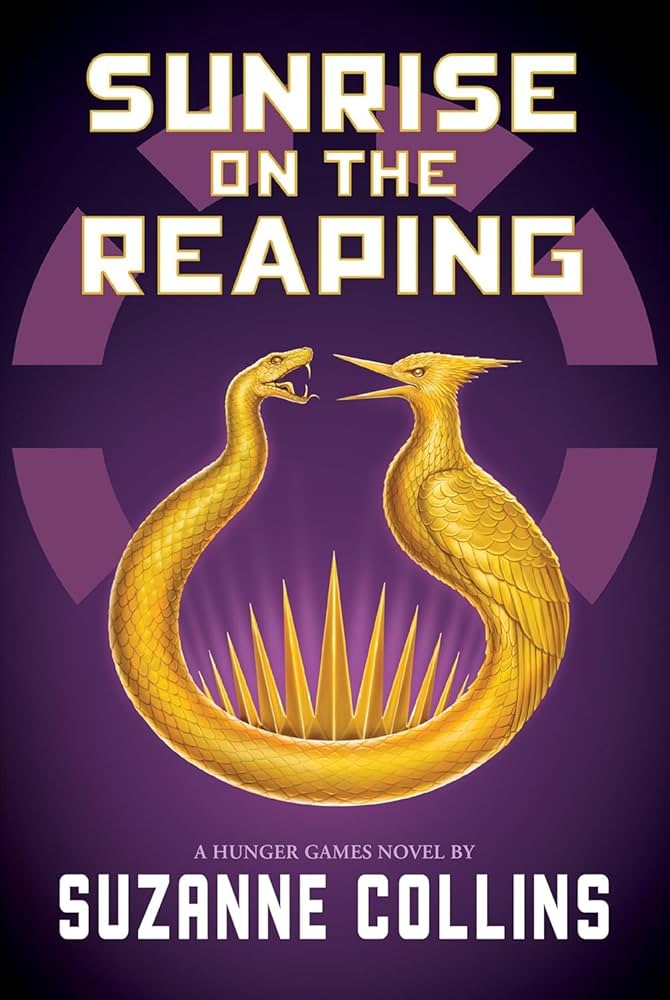
Sixteen years after the release of the global sensation The Hunger Games, critically acclaimed author Suzanne Collins returns to her crafted universe of Panem with Sunrise on the Reaping, adding yet another prequel to the already beloved Hunger Games universe. The book centers on Haymitch Abernathy, a traumatized addict who was first introduced in the original trilogy as the sole victor/mentor for the Hunger Games of District 12. His reward for that achievement? Panem’s tyrannical President Snow ordered all of Haymich’s loved ones to be murdered.
Here Collins pulls the curtain back to tell his backstory. As she explores sixteen-year-old Haymitch’s games, which took place 25 years prior to the events of the original series, Collins does what she’s always done best: draw compelling characters – in this case bringing much-needed context by filling in the blanks of the horrors that Haymitch experienced as a teen.
Similar to her previous books in this universe, Collins skillfully expands on the dangers of propaganda by blending her political commentary with Haymitch’s devastating story. The emotional complexity that flows between all of the characters in the novel is one of its strongest points; as their stories come alive, so does Collins’ message. Although many of the characters are fleshed out as the story proceeds, Haymitch’s girlfriend, Lenore Dove Baird, remains at a standstill. Her lack of development is uncharacteristic for Collins, especially considering how important of a role she plays in Haymitch’s life. Despite this, Haymitch and his fellow tributes in the games – Maysilee Donner, Wyatt Callow, and Louella McCoy – are all deeply nuanced characters. Their development throughout the narrative is as compelling and complex as Haymitch’s, and it forms the story’s foundation. The personal connections that Collins explores among these characters lends an uncanny realism to the story, offering a window into the horrifying life of a Hunger Games victor. At the opening, Haymitch and Lenore Dove discuss the nature of the Hunger Games, just hours before Haymitch is reaped for them:
“Look, it’s okay,” I assure her. “We’re going to be fine.” She nods but the tears keep trickling. “Lenore Dove, we’re going to get through today, just like last year and the year before, and eventually move past it.”
“But we won’t really,” she says bitterly. “No one in Twelve will. The Capitol makes sure the Hunger Games is burned into our brains.”
All of the residents of the districts in Panem (District 12 specified here) carry a sense of hopelessness with them due to the consistent oppression of the Capitol. In the arena, the sickening reality of the Hunger Games is presented from Haymitch’s point of view. Forced to fight to the death, he and his opponents don’t face only physical harm but psychological damage as well. We see this as Haymitch struggles to maintain not only his life but also his sanity during his days in the arena. That the Hunger Games are televised and consumed as a form of entertainment by the elite residents in the Capitol, whilst children, such as Haymitch, are forced to fight for their lives, is a damning testament to the desensitization to violence that characterizes Collins’ world as well as our own.
This remains true: Collins is more than capable of creating a gut-wrenchingly beautiful narrative that is simultaneously enjoyable and eye-opening. The novel’s ending is haunting, and it achieves exactly what Collins set out to do when she wrote this book: give readers a deeper, more nuanced understanding of Haymitch, all while amplifying the same urgent and timeless themes that she has fearlessly explored within all of the Hunger Games books.
Baran Bashar is an incoming freshman at UC San Diego.
 Orange County Review of Books