
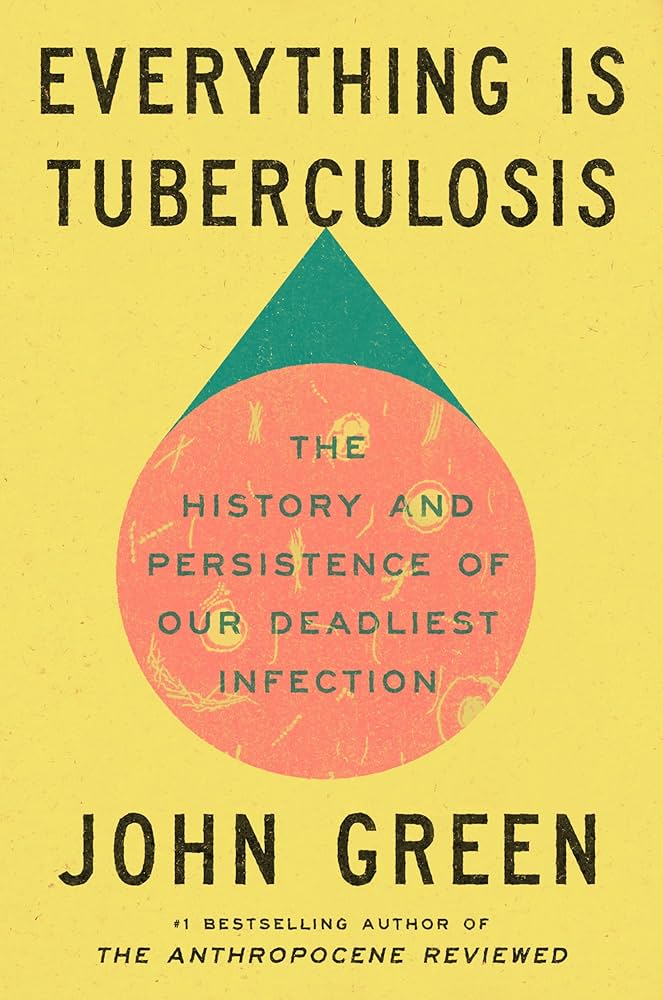
Unbeknownst to most, novelist and YouTuber John Green has taken an intermission from his regularly scheduled programming of Crash Course videos and romance novels to tell us, in his usual detailed manner, about his most niche fixation yet: tuberculosis. His latest book, a work of nonfiction titled Everything is Tuberculosis, follows the life of one beloved and overwhelmingly sick TB patient named Henry who lives in Sierra Leone, Africa. Despite the tragedies that Henry has had to endure, his serendipitous meeting with Green, thanks to an unrelated Partners in Health trip in 2019, provided the turbulent spark that set this book in motion. Although Henry’s experiences form both the inspiration for and the bones of the book, the heavy lifting of Green’s argument – that TB can and should be eliminated – is achieved through persistent use of historical narrative, personal anecdotes, compelling statistics, and even humorous footnotes.
The book centers on the mind-boggling fact that, though we do have a cure for tuberculosis, roughly 150 million people have died of the disease since the cure’s inception. Green doesn’t take the expected route of addressing TB as just another baffling healthcare issue but instead focuses on the myriad of layers, historical and otherwise, that present multiple roots of the problem:
People who are treated as less than fully human by the social order are more susceptible to tuberculosis. But it’s not because of their moral codes or choices or genetics; it’s because they are treated as less than fully human by the social order.
As the narrative dives in and out of Henry’s story, Green grapples with countless factors that have led to the disease’s persistence throughout history, such as romanticism, race, nationalism, and even fashion. These pieces join together to paint a thought-provoking image of tuberculosis for the reader to personally reflect upon.
The book has incredible depth in ways that are only made possible by Green’s extensive knowledge on the subject of TB in combination with his overflowing compassion for humankind, reaching far beyond the simple scientific or social perspectives. His use of Henry’s story to convey his argument is not only brilliant in evoking empathy and amplifying different voices, but showcases what it’s like for each of us to be human, to have lives and choices.
Parts of the book step slightly off route in what seems to be anger from Green, who personally deals with many hardships caused by other diseases in his own life. Though these parts may read as a frustrated cry for action, they also leave a lingering sense of empowerment in individual choice and our society’s potential to care for one another rightly. Hopes, dreams, fear, and misery all converge on a TB patient simultaneously, and it’s marvelous how Green manages to convey this complicated experience, from one patient to the next. The book ignites a feeling of shared priorities over greed and ignorance, and though it frequently launches into an expository mode (always peppered with fun facts), these excursions are necessary to communicate his concluding perspective.
Viewers of his Crash Course videos will thoroughly enjoy Green’s first-person narration, which is reminiscent of his demeanor in the videos. His distinct tone and talking pace are warmly recognizable in his writing, helping viewers to be equally attentive to the book’s main topic as well as to his amusing but relevant side tangents. The book contains plenty of obscure (and, occasionally, witty) pieces of history that don’t take away from the seriousness of his argument, but rather reinforce it by revealing TB’s vast reach across all of human history. In the more somber chapters, harsh realities are superimposed onto the reader through undeniable evidence and worldwide experience to clearly announce the pressing need for global access to the cure. It’s as if Green reaches out his hands and unmasks us, hoping that we might see historical, scientific, and cultural connections to the disease that were there all along. Additionally, the chapters are relatively short and digestible. These components combine to maximize the book’s potential audience, magnifying the theme that, far from being a distant issue, far from being a nonissue in the “developed world,” tuberculosis is, in fact, the human issue – not to be dismissed through stigmatization or romanticization.
While the little twinges of pain brought about by this book are inescapable, they are undeniably necessary to fully grasp Green’s point. This discomfort certainly comes into play when seeing that wealthier societies seem to collectively determine the fate of people living on completely different continents: we choose what to invest in and fix. It’s hard not to be left truly moved, desiring to understand the value and meaning of just one person. Why deprive the world of its opportunity to prosper through the work of people who become all the more grateful for their lives, who love others and know the value of redeeming their time? This is not a book that will tell you what to do, but it is a reprimanding conversation: the solution has been here for decades, and it’s time to choose it. If Green had it his way, this message would be blasted throughout every neighborhood, city, and place on the earth, because TB’s unnecessary reign ought to come to a bitter end, not years in the future, but now. After finishing the book, it’s hard not to submit to this notion alongside him. This call-to-action involves doctors, lawyers, and major pharmaceutical corporations…but it also involves the person reading the book.
Claire Vaughan is a devout Christian and an incoming freshman at Cal Poly San Luis Obispo.
 Orange County Review of Books