
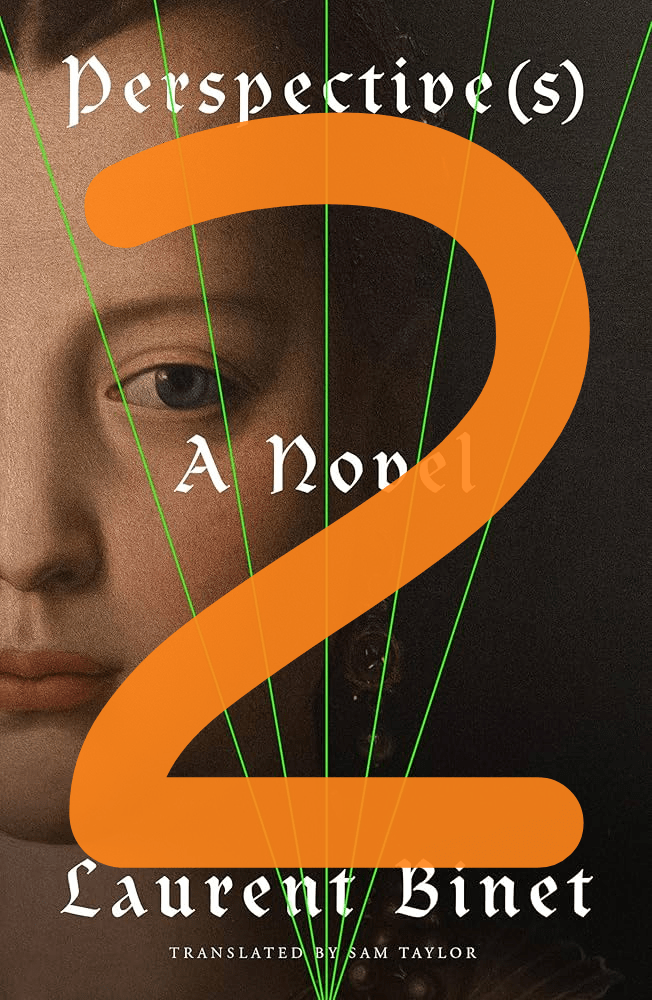
Brought together by scandal and tragedy, the multitude of historically significant characters of Perspective(s) present various viewpoints, each offering a window into the cultural and societal norms of our distant past. With this in mind, readers may approach Laurent Binet’s newest novel with both intrigue and trepidation. An intricate web of letters, between figures of history we hold in such high regard…for a moment, the reader may wonder whether they are setting themselves upon a journey through muddled antiquity, a compulsory dictionary and twenty tabs of Wikipedia open at their side.
But the experience Perspective(s) serves proves to be quite the opposite. Written as a modern murder mystery set in the sixteenth century, Perspective(s) is a breezy yet engrossing story of censorship, suspicion, and betrayal. This onslaught of letter correspondence is set into motion with the discovery of controversial painter, Jacopo da Pontormo, left lifeless on the floor of the San Lorenzo church before his fresco, a chisel lodged in his chest. The culprit? It could be anyone from his assistants, fellow esteemed painters, artistically-inclined convent prioresses, or any one of the other colorful characters we encounter along the way. Further investigation into Pontormo’s sudden death will reveal an additional conspiracy – a provocative painting of the daughter of the Duke of Florence that could place the family under scrutiny by the conservative and restrictive pope and the tightened Florentine regime.
Famed art historian Giorgio Vasari is selected by Cosimo de’ Medici, Duke of Florence, to investigate the murder, which proves to be a lot more convoluted than he once thought. The fresco Pontormo was painting moments before his murder has been continued by another hand, and there appears to be outside intrigue in Pontormo’s work – particularly, his lewd depiction of Maria de’ Medici as Venus.
Many may be initially intimidated by Perspective(s)’ seemingly neverending cast of characters. The letter format often doesn’t lend itself to many physical descriptions or deliberate character introductions, so how is the reader to easily tell Borghini from Bronzino, one nun from another? Each letter is deeply infused with its writer’s unique personality and perspective, turning a daunting list of names (one which Binet provides at the beginning of the book) into a rich and colorful cast of characters, each one open to the reader’s suspicions of murder. Cellini, the adventurer hired to smuggle Pontormo’s Venus from Cosimo de’ Medici’s closet, provides some of the most engaging letters. The record of his exploits – say, of sneaking past guards and through walls – provide a very fun and refreshing break from ruminations regarding the murder case itself.
One of Perspective(s)’ greatest strengths is its fluidity. Of the novel’s plethora of characters and subplots, not a single one falls flat. From the internal drama between the younger and elder Medicis to the congruent uprising of artists against Florence and the swashbuckling adventures of Cellini, Perspective(s) is consistently gripping. The constant shifting from one focus to another doesn’t interrupt the story’s flow but rather maintains engagement. There is never a good place to bookmark – the reader will feel compelled to follow Vasari to the bottom of the crime, even if it means staying glued to their seat for hours.
Curiously, despite its written letter format, Perspective(s) often leans dialogue-heavy. Every letter is a message from one character to another, whether speculations of a suspicious figure or assessments of the kingdom’s current climate of censorship. Binet tends to underutilize his proficient ability to write action sequences, which, while few and far between, are some of the novel’s highlights. His inclination to overexplain (notably via Vasari’s periodic reports to Cosimo de’ Medici, too much telling and not enough showing), sometimes hampers the narrative’s snappy pace.
For anyone who enjoys varying points of view, shifts in art over time, or even just a good old-fashioned whodunit, Perspective(s) provides a brisk afternoon read of the type to which all historical fiction ought to aspire: the book inspires further research into the time period’s moral and cultural disputes, as well as its various pieces of art. Studying Pontormo’s frescoes and Venus for oneself brings a kind of clarity to the novel – an ironic smirk in the understanding that this is what all of our passionate correspondents were fighting over. The struggle over censorship and the appreciation of arts also carries relevance to our modern climate with the key questions of “What makes art?” and “How does censorship impact the delivery of an artist’s message?” With this in mind, readers can assess Perspective(s) as a commentary on the receptions and meanings of art, tapping into their own artistic perspectives as they read along.
Claire Elliott is an aspiring writer and incoming freshman at the University of Southern California.
 Orange County Review of Books