For a Rembrandt, a Van Gogh, or a Banksy, Google Images usually does the trick. But for the work of British artist Ed Atkins, what you really want is YouTube. In his weirdly hypnotic computer-generated animations – urine arrives from off-screen to fill a whiskey glass; a man hums the drumline from Ravel’s Boléro while repeatedly ripping the skin off his own face – anything can happen. It should come as no surprise, then, that Atkins’ work as a writer also slants toward the strange, the surreal, and the startlingly hip.
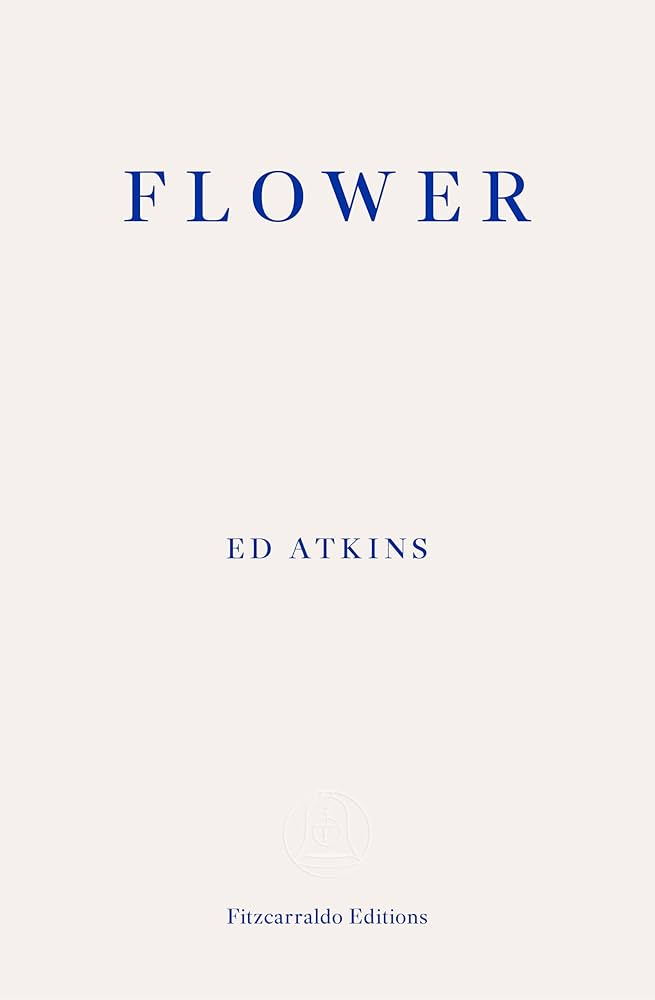
Indeed, if the world of contemporary art is largely a gated community (and it is), then Atkins’ new book, Flower, wants to belong to the literary equivalent of that space. One is, for starters, immediately exasperated by the book’s preposterous formlessness: in all of a hundred pages, it manages to dispense with line breaks almost entirely. Of course, paragraphlessness is not the exclusive domain of the dead – Kafka, Beckett, and Bernhard all did it – but such an explicit style choice should be buttressed by something sturdier than the author’s whim.
Here’s what Flower does right: it models itself on a superb book, its obvious predecessor, Edouard Levé’s Autoportrait (which itself looks back to Joe Brainard’s entertaining memoir, I Remember). All three books have this in common: the author’s desire to portray himself through an assemblage of discrete, often jarringly disjunctive statements, rather than a continuous narrative. Somewhat unexpectedly, Levé’s achievement rests on a stable foundation of mostly short, prosaic, humorless sentences. How does Flower kick things off?
I like eating cold, clammy wraps from big pharmacies that are open late and sell just a few foods like protein bars and powders. I like wraps near the skin creams, neoprenes and scrunchies. I also like the wraps they sell in cheap supermarkets and franchise corner shops and mid-tier garages. The cheap supermarket near me sells just a few lunch things they don’t have an obvious lunch bit. The few wraps they do sell are really close to the tills, seemingly on the wrong side of the tills you have to know they’re there otherwise when you do see them it’s probably on the way out, too late to think to buy one.
The book’s silly, mundane, frequently off-the-wall confessions aren’t in the business of being spellbinding or consequential. No, Atkins is at his most amusing when he simply submits to his neuroses. By turns obsessive, cringing, and self-aggrandizing, the book’s key fascination is its capacity for tortured expression (teeth are “burdened bones”; self-love is “an unobservable phenomenon that cavils forever”). Thesaurus in hand, Atkins’ style sometimes slips into a surprising sublime (“There were yolk-coloured chanterelles crowding under the trees in the Engadin but it was a monochrome of inkcaps and puffballs on the lawn at home.”). Otherwise, repulsive, harmless, or droning, he certainly isn’t capable of writing the same sentence twice:
I like to put my cigarettes out in the food. Here’s my cigarette, driven slowly into the icing on my cake with the cigarette going a loose z-shape and a tiny crazed crater opening up in the matt icing like a cartoon rocket’s nosecone crumpling up when it bonks into an iron moon. Here’s my cigarette being wrong again, dipped into the hummus and here it is dunked into my gravy on a round white plate. Here’s my cigarette hissing out on meeting the water in the toilet bowl.
Likes collides with dislikes; hope does its dance with dread. All of this happens inside Atkins’ head. His idiosyncrasies occasionally shade toward universal experience, but only occasionally. Like a mosaic minus its mortar, the pieces have nothing to grip them, no formation to assume with finality. Sections on Cool Ranch Doritos, vaping, and mobile gaming all make this a book of our time. So, too, do the abrupt shifts from one topic to the next, which tilt the reading experience toward the same vague discontinuity of any popular algorithmic feed: it’s a diet of stuff, some of it fascinating, most of it not. There’s so much of it crammed in here, custom-tailored by Ed Atkins, for Ed Atkins.
Eric Bies is the founding editor of Orange County Review of Books. His essays and reviews have appeared in World Literature Today, Asymptote, Open Letters Review, Rain Taxi, and Full Stop, among others.
 Orange County Review of Books