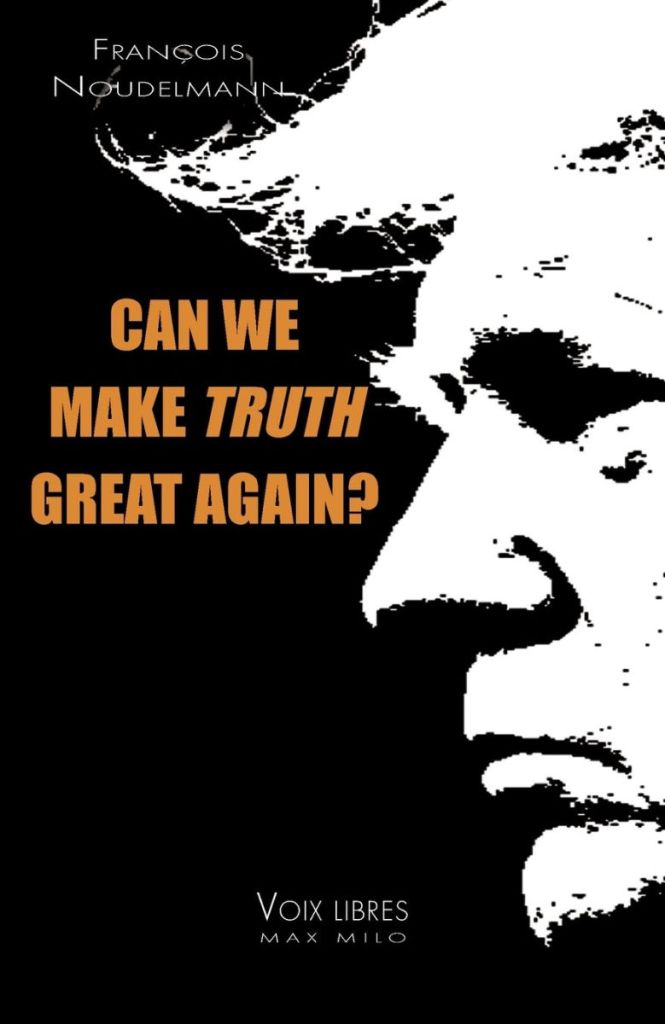
Can We Make Truth Great Again?
By François Noudelmann
Max Milo Editions. 2025.
Reviewed by Anthony David Vernon
Call it misinformation, disinformation, or “fake news”: false truths, illusory truths, have always played a prominent role in the shaping of American opinion and political sentiment. While Donald Trump may be that pattern’s greatest modern exponent, he didn’t invent it. But what is it about our current moment that fans the flames of these tendencies? And is there any way out of the inferno? As François Noudelmann argues in his newest book, Can We Make Truth Great Again?, “We have entered the age of post-truth, where nothing is true or false.”
A trained philosopher and professor of French literature at New York University, Dr. Noudelmann’s book studies the phenomenon of a “post-truth” society, investigating the “alternative facts” and feeling-based politics that dominate our contemporary discourse. He sees the issue everywhere, not just at the margins, saturating both wings of the body politic. His argument centers on the notion that American society no longer values objective truth.
How did America fall for false truths in the first place? According to Noudelmann, Americans give too much credence to their feelings. While it may be tempting to assert that “facts don’t care about your feelings,” the truth is that humans have always registered both in tandem; we have always had, Noudelmann writes, “[a] bias [which] leads us to deny that a fact is actual.” History has never known a moment in which all people agreed about all the available facts; such a notion verges on the mythical, and probably always will. Is it even possible to hold an objective truth independent of feelings?
Noudelmann suggests that we stand at the summit of feelings-based politics in America, and thus have reached the peak of post-truth thinking. But to state that “[t]he proliferation of lies [has] reached an unprecedented level” somewhat misses the point of how societal lies actually operate. There is no such thing as “peak truth” or “maximal lying,” let alone any inherent measure of truth or falsehood. The truth has always registered in view of a range of perspectives. The truth has not always been rational, either; the Pre-Socratic Greeks allowed themselves to be led both by fate and by feelings. Emotionality does not always lead to authoritarianism; nor does rationality necessarily guide one toward liberty. These are not universal conditions. Yet, Noudelmann writes, “[g]overnment by emotion has always been the hallmark of authoritarian regimes.” He notes that democracies were always supposed “to appeal to the reason of citizens,” but he forgets that Athenian democracy – the first of its kind – largely persisted in a feelings-based, irrational society. By contrast, the rationalistic, legalistic order of Qin Shi Huang led to a great deal of authoritarianism.
Clearly, we cannot equate all feelings-based societies. It is human nature to be inconsistent, granting significance to one fact and insignificance to another. Truth cannot be isolated from post-truth. But are all post-truth statements not equally deleterious? What does it matter, in the case of rewriting pure fiction, whether “Carmen kill[s] Don José,” and not vice versa? Is there any truth to be found within fiction alone?
Post-truth discourse becomes particularly problematic when it is used to target individuals or groups. Noudelman cites the accusation, propagated by Donald Trump during his 2024 presidential campaign, that Haitians were eating household pets. How facts and falsehoods are used does matter. Carmen killing Don José produces zero harm in the context of entertainment, but if I were to use such a retelling to promote androcide, that would be a different situation entirely.
Noudelmann’s argument suffers from the conflation of all post-truth propositions, but his book offers a welcome assessment of contemporary political speech. He is correct to sound the alarm – Pandora’s box has been opened, and there may be no method for closing it. Those seeking to thwart the fascist cause may need to supplement objective truths with their own variety of false truths. As Noudelman writes, “Awareness of these perverse uses of truth does not mean we should doubt [them] on principle.” Post-truth discourse, in partnership with objective truth, can offer a convincing set of joint facts and feelings. When we see “[t]he multiplicity of viewpoints and [go about] using them,” we can make the truth great again with the help of a feelings-based politics. We should be loath to let those who wish to harm others have the post-truth tactic all to themselves. There does not need to be a “[s]eparation between a system of beliefs on one side and objective truths” on the other. At this juncture, both the truth and the post-truth, properly applied, can and should be effective partners in the pursuit of a free and harmonious society.
Anthony David Vernon is an adjunct professor of philosophy at St. Thomas University (Miami Gardens) and Miami-Dade College.
 Orange County Review of Books