
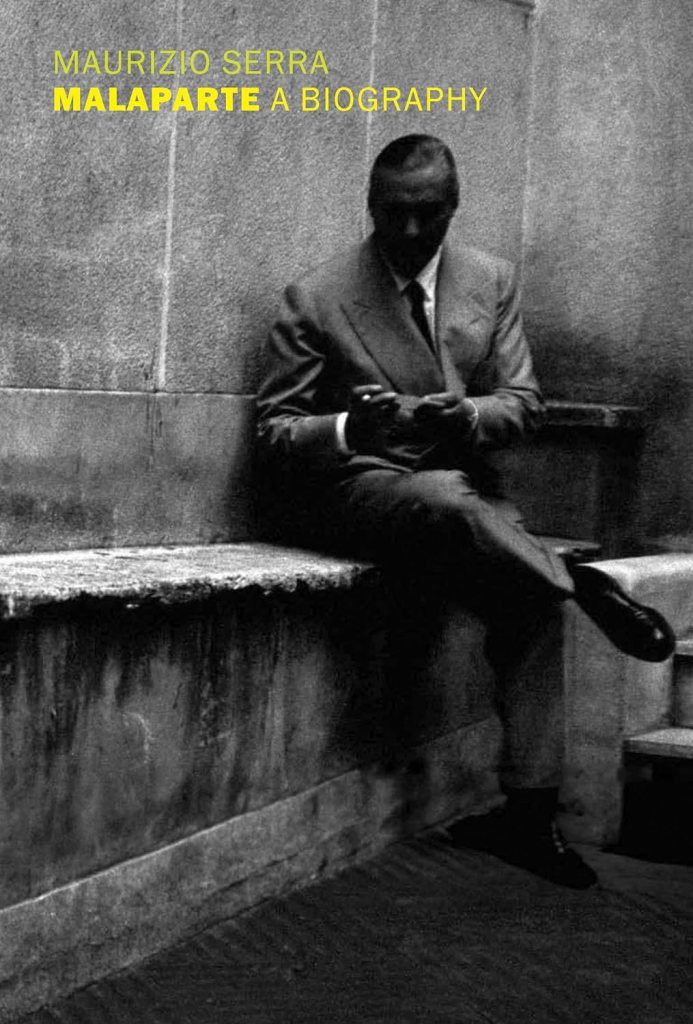
“The best part of a writer’s biography is not the record of his adventures,” Nabokov told an interviewer, “but the story of his style.” Nabokov was surely right, but there are writers the clarification of whose adventures assist rather than distract readers. Curzio Malaparte (1898–1957) is one, and not simply because he was a seemingly chameleonic mythomane, and a very complicated figure even in the complicated politics of his times. He is also the perfect specimen of a type of writer still somewhat strange to English and American readers: the orator, the publicist, the literary courtier; at higher reaches, the poet become diplomat, the novelist become minister of culture. Austen, Flaubert, and Joyce – to name just three for whom the life is the style – don’t really need more biographies; leave the greatest writers in their hermitages, and let us follow Maurizio Serra to Malaparte’s Rome of the 1920s, so like Baudelaire’s Paris of the Second Empire, Louis Napoleon and Mussolini alike imperators sprung from the murk of conspiracy and police spying, of street fights and censorship, where modern literature evolved alongside La Technique du coup d’État.
Serra finds twenty-one year old Malaparte, then still Kurt Erich Suckert, in the crowd of Great War veterans demobilized into uncertainty, sometimes into chaos, and finding their ways to the standing temples – or the new, makeshift camps – of this or that faith. Malaparte was inclined to Fascism by his loathing for bien-pensant bourgeois, by an anticlericalism that would be lifelong, and by his wartime experience of trauma and camaraderie (as he wrote of the Garibaldi Legion, a volunteer corps that fought under the French while Italy was still neutral, “for me it was the prelude to Fascism”). Simply put, Fascism, at first, promised to complete the work of national unification and revitalization in a militant, ascetic style he could understand.
Before going off to war he was well-known in Prato, the Tuscan city of his birth, as a speechifier and banner-carrier in the youth league of the Partito Repubblicano Italiano (PRI). “Sometimes he blended in with other groups, just to get into the middle of the protest,” Serra writes of the still-schoolboy, “and he was even arrested at anarchist strikes.” To complete his readiness for extremism, Malaparte had the requisite family trouble: a difficult relationship with his nervously fragile, financially unstable father, a weak man given to rages. To Serra this case “recalls that of the adolescent who turns into a rebel because his father is not a natural authoritarian.” Mussolini would become, and always remain, “the Vaterfigur of his existence,” writes Serra, “the incontestable, untouchable, indisputable father…a natural authority, in short.”
Despite – or because of – the torrent of hardline, insistently idealistic propaganda Malaparte produced from the formation of Mussolini’s first government in 1922 – “you catch glimpses of an authentic writer,” notes Serra, “an original polemicist rather than a mere hack like the majority of his peers” – the emerging dictator kept him at arm’s length, and he would never become a power in the party. Piero Gobetti, “promoter of an audacious synthesis of liberalism and socialism,” editor of the anti-Fascist weekly Rivoluzione Liberale and a close friend – Serra calls him the second “decisive influence” in the writer’s life, after Mussolini – watched Malaparte’s vain efforts to fit in and to rise. Gobetti included this warning in a letter of 1925:
Dear Suckert, now would be the time for you to get serious. Don’t you understand that you’re wasting time, that the Fascists are playing you, that in the party you’re a fifth-class man, that your writings for the past year haven’t been worth a damn? I think it’s right that you stay in the Fascist Party, because you’re a born Fascist, one of the authentic ones. But show some presence of mind: you are a born artist and must not lose yourself completely.
While Malaparte may not have “endorsed” Gobetti’s diagnosis at the time, as Serra argues, he certainly heeded it. He never lost himself completely. Not that he could. He was true to himself, and that self was mercurial, contrary, and narcissistic; quickly bored by the facile, and fond of viewing the world from different vistas; in a word, writerly. As a novelist, correspondent, publisher and editor, he pursued diverse interests and ventures, with a healthy disregard for factional consistency. He spooked timid souls, angered narrow ones. From the late twenties through the war, he would seek favor, seek notoriety, and seek above all Mussolini’s attention – but he “would never be a faithful hack, ready to fall into line.”
Serra dislikes the label of “chameleon,” first affixed by Gramsci, that follows Malaparte like “a second pseudonym,” Don Camaleo. Serra shows that Malaparte’s style and personality remained remarkably coherent over time. And his itinerary is no more a portfolio of contrasts than those of most of his contemporaries in an era that we must remember was a freaked interval between two apocalyptic social upendings. I would say that Malaparte, with his politically unclassifiable career, is what you get when an apolitical artist – and I think all real artists are essentially apolitical, pursuing Pateran “secret errands” whatever their external sympathies – inhabits an over-politicized milieu, one in which every book published, every magazine launched, every friendship, declares itself – or is assumed to declare itself – for or against some other thing. A milieu, nightmarish to my mind, in which factional distinctions are superfine but always changing, capriciously drawn but physically consequential. Malaparte seemed to enjoy this – but before I add “to his detriment” I remind myself that he was fully a creature of his environment, and took his inspiration from it. For him life was “a fusion of writing and combat.” Inside him was no hermit dreaming of a misted mountain. He hated ivory towers and, like Akhmatova, saw voluntary exile as a form of suicide, a death in life. So, “to his advantage.” Serra’s fine book affirms that Malaparte in exile or in retreat does not write a masterpiece like Kaputt. And masterpieces are all that count.
Eric Byrd is a librarian and archivist living in Minneapolis-St Paul, Minnesota.
 Orange County Review of Books