
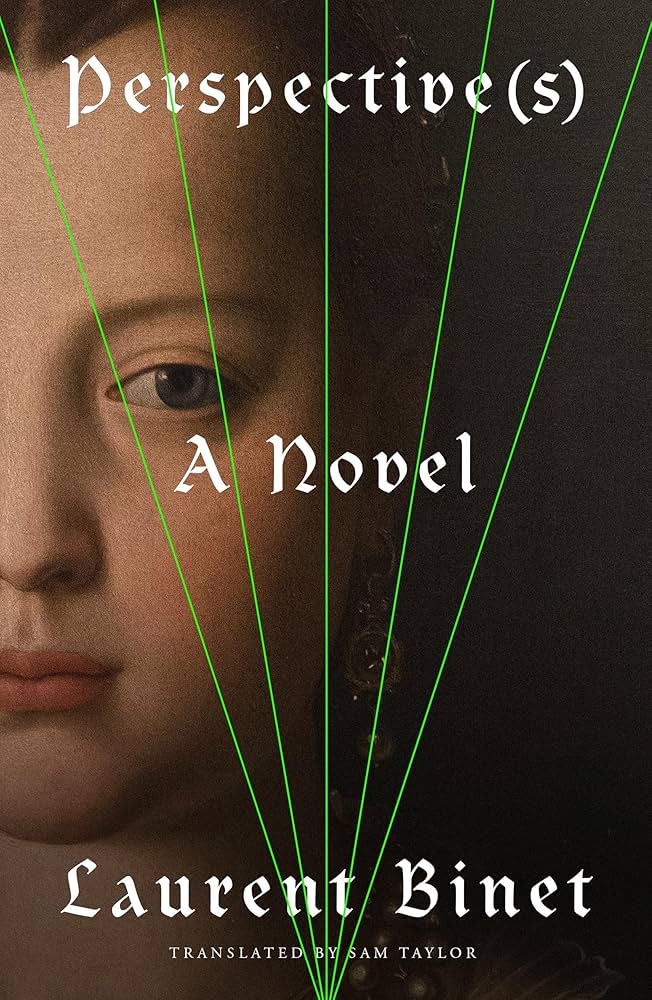
Laurent Binet’s new novel, Perspective(s), is a criss-crossing, polyphonic thing – a chatty, omnidirectional epistolary novel set against the politically turbulent backdrop of sixteenth-century Florence. Most of the novel’s characters are recognizably historical, and the nearly two hundred letters that fly between them reconstruct an entire milieu: from Cosimo I de’ Medici and Eleanor of Toledo to Michelangelo, Bronzino, Benvenuto Cellini, and several of the artist’s apprentices, everyone crops up to have their say – and they have a lot to discuss: their restless communications circle the body of a dead man, and, like Murder on the Orient Express, this murder mystery’s narrative swerves – it constantly shifts perspective – to make a suspect out of each of them.
The novel begins on the first of January, 1557, in an Italy still awash with the fading glory of the High Renaissance. Leonardo and Raphael are dead – no mystery there – but Michelangelo remains at work on the dome at St. Peter’s in Rome (a bit fearful that the new pope might decide to vandalize his Sistine ceiling). In Florence, however, forget God: it’s the Medici who rule with complete power, and the ever-scheming duke has his eye on a strategic marriage for his daughter, Maria.
But when one of his best artists, a man named Pontormo, is found dead in the chapel of San Lorenzo (a sculptor’s chisel buried in his heart), it isn’t the unfinished state of his frescoes that disturbs the duke. The problem is another painting, one that Pontormo did finish. Inexplicably, days before he died, he’d taken it upon himself to paint a portrait of the duke’s daughter – the same one positioned now for marriage – scandalously mounting her face on the body of a nude Venus. Worse, the painting has vanished.
To head the investigation, the duke enlists Giorgio Vasari. Better known as the author of The Lives of the Artists, Vasari’s characterization in the novel more accurately reflects his real day-to-day role as a kind of cultural-minister-cum-do-all for the Medici. His letters form the core of the story, his efforts at detection spidering out into a complicated series of dead ends and fortuitous discoveries. But just as many conversations branch off from his, or else keep to the shadows entirely, and the atmosphere of gossip that emerges is delicious (it’ll make you feel like you’re eavesdropping on history). Still, the novel’s most impressive quality is its knack for modulation: tone, diction, and style undergo the same kind of stable flux that has always distinguished one letter-writer from another. Binet is so good at this that it often only takes him a couple of sentences to establish each voice on the page. Vasari, for instance, is all business, a bit of a suck-up but also a bit of an arrogant dolt. Michelangelo manages a mix of irascibility and magnanimity, often both in the same breath. The most fun, though, always, is Cellini, who never tires of reminding people that his Perseus stands next to Michelangelo’s David, and whose every letter hoots and hollers like the best, most unbelievable adventure story you’ve ever read.
Perspective(s) is just like that – a splendid mélange of unreliable narrators. Sam Taylor’s expert translation brings their voices to life, and the string of mysteries they conspire to unveil, one clue at a time, isn’t just absorbing; the pages practically turn themselves. This marvelously imaginative novel isn’t just lively; it’s the definition of rollicking. Binet has done it again.
Eric Bies is the founding editor of Orange County Review of Books. His essays and reviews have appeared in World Literature Today, Asymptote, Open Letters Review, Rain Taxi, and Full Stop, among others.
 Orange County Review of Books