
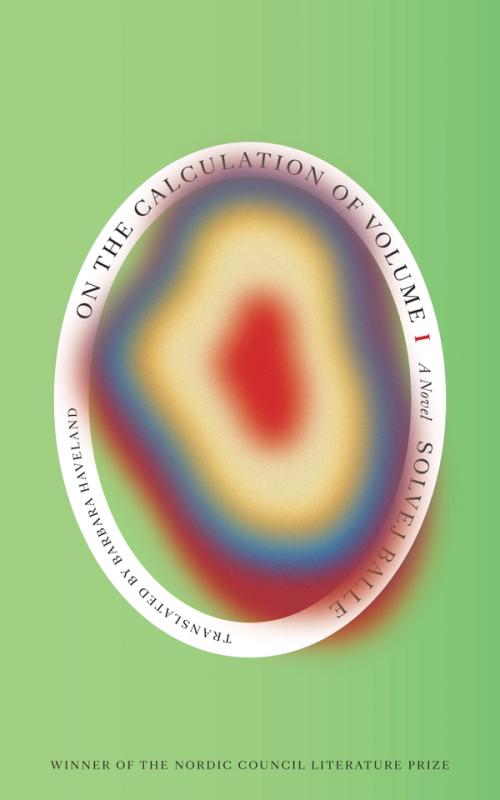
Danish writer Solvej Balle’s seven-volume novel series On the Calculation of Volume is not Groundhog Day, but its premise is similar enough to summon constant comparison. Like Bill Murray’s character in the movie, Balle’s narrator, an antiquarian book dealer named Tara Selter, also finds herself stuck in an endless loop of the same day. The difference is a matter of space: her experience of it, unlike that of Murray’s character – who wakes up in the same bed, in the same room, no matter what he does during his waking hours – is comparatively free. If she falls asleep in a different bed across town – or in a gutter, for that matter – then that’s where she wakes up.
The first book in the series takes the form of a diary – the items Tara totes around are also, mysteriously, immune from the day’s recurrence – and it opens on her 122ⁿᵈ entry, that is, her 122ⁿᵈ unique experience of the same day:
It is the eighteenth of November. I have got used to that thought. I have got used to the sounds, to the grey morning light and to the rain that will soon start to fall in the garden. I have got used to footsteps on the floor and doors being opened and closed. I can hear Thomas going from the living room to the kitchen and putting the cup down on the worktop and before long I hear him in the hall. I hear him take his coat from its peg and I hear him drop his umbrella on the floor and pick it up.
Thomas is Tara’s husband and partner in the book trade, and the scene’s setting is their house in the fictional French town of Clairon-sous-Bois, but this isn’t where her story begins. Tara spends her first eighteenth of November in Paris, in what is supposed to be a brief stop on her way home from a rare book auction in Bordeaux. It’s only after noticing, the next morning, that the newspapers all carry the same headlines, after watching the same man in the hotel restaurant fumble a slice of bread in an identical manner at breakfast, after picking up on a whole string of such troubling coincidences, that she calls up her husband to describe her dawning realization.
Not that she knows, exactly, what’s going on, not yet. Still, Thomas hangs onto her every word, and yet – credulous or incredulous – his reaction is ultimately irrelevant. Even after Tara takes the train home to tell him in person, Thomas wakes up the following morning as though they’d never spoken. The first time he wakes up next to her, in fact, he’s shocked: isn’t she supposed to be in Paris today?
The book’s setup is gripping, and Balle’s straightforward prose reliably renders the oscillating tones and textures of a diary kept under such uncanny conditions. Day #122, of course, opens with a degree of faltering familiarity, but the book’s best stretches are the expository ones, those that flash back to Tara’s discoveries, her experiments, her attempts to break free of the eighteenth of November.
Cracking past these scattered bits of world-building, however, Tara’s entries grow increasingly monotonous. Curtailed by the limits of her day, her entries zoom in to account for all the bristling detail over which, for lack of time or attention, we usually gloss. Sometimes this flood of noticing feels like padding, like so many Styrofoam peanuts, like an exercise in mimicking Georges Perec’s An Attempt at Exhausting a Place in Paris (which crusts over after about the fifth page of exhaustive observation). Other times it’s reminiscent of a tale by Borges, whose “Funes the Memorious” ingeniously depicts the mental travails of a young man doomed to remember, well, everything, from the quality of the light last Tuesday at 10:31am to the number of ice cubes in his glass at the same time, on the same day, two years prior. The difference is that Borges wraps things up in six or seven pages.
This is a short novel, but few novels of any length that stretch their middles as much as this one can justify their longueurs. This one does, barely, and not by the virtues of its prose but with a worthwhile conclusion. It’s the first in a series of seven, and its arrow points dutifully to volume two. Hopefully the others are brave enough to accomplish much more in as little space as this one does.
Eric Bies is the founding editor of Orange County Review of Books. His essays and reviews have appeared in World Literature Today, Asymptote, Open Letters Review, Rain Taxi, and Full Stop, among others.
 Orange County Review of Books