
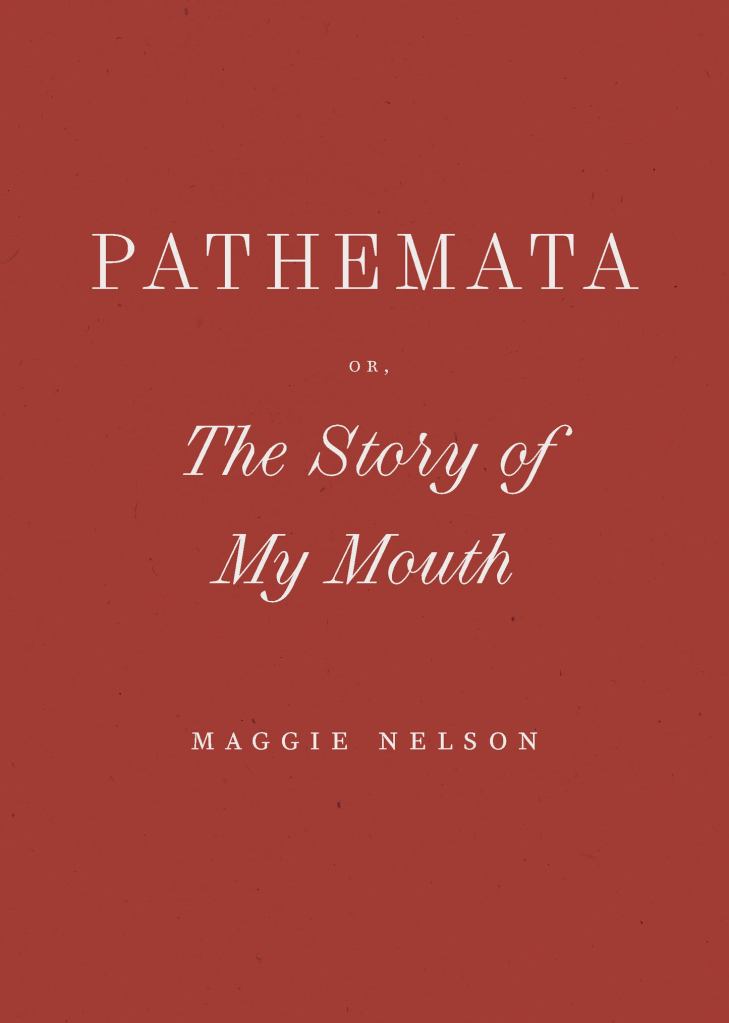
Maggie Nelson’s latest book, Pathemata, Or, The Story of My Mouth, is a poetry book posing as a prose one. Or it’s a prose narrative so interwoven with poetic convention that its eyes cross to see itself in the mirror. Its airy pages, at any rate, look like the pages of a poetry book. Their fundamental unit of composition might appear to be the well-padded paragraph. But the paragraphs are actually stanzas. And the stanzas were crafted with a sensibility for rhyme – but not the kind that rings out between similar or identical sounds. Nelson rhymes sentiments, sensations, and scenes.
A constellation of such rhymes, Pathemata charts Nelson’s hopscotching search for a cure to her chronic jaw pain. On the face of it, the book is a medical memoir, but it eludes the typical pitfalls of the genre. Skirting every mechanism of cheap manipulation, Nelson pursues a characteristically nuanced course of discovery, and goes all in on the quintessentially poetic conception that a mile of meaning can be packed into an inch of metaphor. A number of her other books have penetrated the complicated airspace of psychological and emotional pain, typically with ample research and insight. Here, dropping away from those brainier heights, she draws closer to the ground to confront the appallingly monotonous reality of physical pain. At the book’s opening, in lines that bear savoring, she wakes to it.
I get up first to be alone, and also because my jaw hurts too much to stay in bed.
Each morning it is as if my mouth has survived a war – it has protested, it has hidden, it has suffered.
It has floated, its miniscule points of contact have hit and repelled, pain has shocked then pooled up around the joint.
Rather than each other, my teeth find cheek, which they masticate, leaving in their wake two mountainous ridges.
I shove the sheet into my mouth to know that I am still here, still rooted to the crust.
The pain affects the way she sleeps, the way she speaks, the way she eats, the way she relates to family, friends, colleagues, students.
In the pattern of episodes that follow, Nelson submits to a battery of tests and procedures at the hands of various experts. One dead end follows another, and the result is a compounding sense of discouragement and resignation. Increasingly unorthodox in her approach, she expands her criteria, often to comic effect. When she meets with “a Lyme doctor […] on the internet, a renowned one who apparently treated Amy Tan,” the reader is bound to laugh along at the absurdity of the situation: this isn’t just any old doctor, but a writer’s doctor. (Nelson discovers she doesn’t have Lyme Disease.) In the course of her journey, she attends a slew of Buddhist discussion groups, mulls over the idea of snipping her frenulum (that strip of tissue that tethers the tongue to the floor of the mouth), and seriously considers undergoing a series of Botox injections to calm her overactive jaw. When she chooses to “hold out,” it’s because she realizes “that the only thing that frightens [her] more than pain and its viciousness is numbness, paralysis.”
Further complications arrive in the form of a virus that paralyzes – the worst of Nelson’s suffering running parallel to the outbreak of the COVID-19 pandemic. Ordered to shelter in place with her young son and distant husband, struggling to navigate a long-distance relationship with a dying friend, badgered by the mystery of her father’s untimely death, Nelson spirals, obsessively journaling her dreams right alongside the progressively obsessive minutiae of her medical odyssey. Her dreams tip toward the nightmarish end of things, ranging from the stereotypical (teeth falling out) to the vividly real (talking to her husband over the phone) and the patently surreal (her “nine-pound white poodle” morphing into a “medium-sized dog made of nubby green fabric”). One of the book’s tricks is to relate these dreams without tagging them as such. Occasionally it’s unclear what’s real and what’s not, so that Nelson’s fraying sense of reality becomes our own. When, finally, she does find a cure for the pain, the scene follows on the heels of a hellish one in which a house catches fire across the street from Nelson’s home – maybe a dream, maybe not – and the sense of anticlimax is as humdrum as anything. It’s just like the sages told us: there is no destination, only points on a journey.
Nelson has never been in the business of tying bows, and Pathemata contains more questions than answers. Unlike The Argonauts, however, there’s nothing sleek, polished, or carefully contrived about it. It is a book by Maggie Nelson, so the sentences do sing (if plaintively) and the degree of self-reflection is superhuman (if tortured). But as far as Nelson’s other books go, this one is refreshingly rag-tag, and reads like a living document – another voice to join the growing chorus of belated COVID books – the hard-bitten expression of a brilliant writer foraging for material in an unfamiliar world.
Eric Bies is the founding editor of Orange County Review of Books. His essays and reviews have appeared in World Literature Today, Asymptote, Open Letters Review, Rain Taxi, and Full Stop, among others.
 Orange County Review of Books