
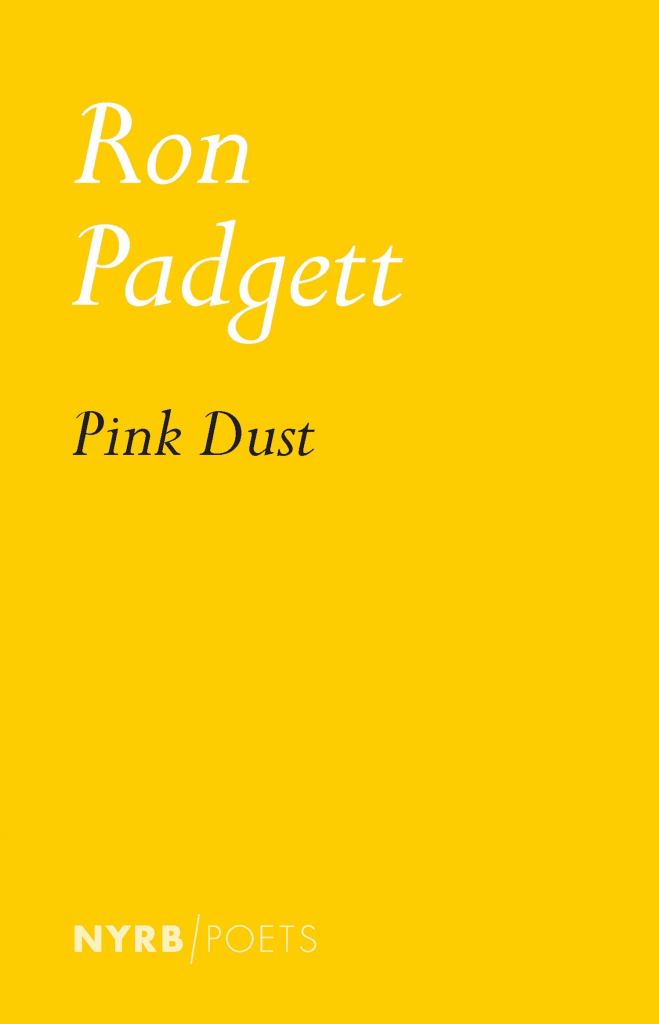
At 82, the American poet Ron Padgett is an old man. In his latest collection of poems, Pink Dust, he admits as much. In the untitled poem that opens the book’s second section (appropriately titled “Geezer”), he writes:
As a young man I wanted to live
a long time so I could know
what it feels like to be old.
Now I’m trying to remember
what it feels like to be young.
Poets have never enjoyed a healthy life expectancy, so Padgett’s perspective, his remembering youth at a distance, is novel. The fact that Coffee House Press published his Collected Poems more than a decade ago is telling. At more than 800 pages, such a volume can’t help but assume the august contour of a headstone. (That the book was prepared by its own author is not itself an unimaginable gesture: prior to his death in 2019, the critic Clive James penned his own obituary.) Pink Dust is, to a considerable extent, an answer to the question that inevitably haunts these reflections: “What does a poet do at the end – after he’s already done it all?”
Mostly, it turns out, he does what he’s done all along. Padgett’s poetry at 82 is a testament to the notion that the fire of style is inextinguishable. Few poets (Pound, Pessoa) have possessed either the ability or the inclination to be protean about this flame. For Padgett, a long and fruitful career as a translator of French poetry seems to have scratched that itch. Otherwise, it can be difficult to tell an early poem from a later one. In Pink Dust, the same qualities he was making his trademarks in the 1950s abound: the colloquialism, the humor, the playfulness, the subtle arrangements of sound. One difference, at least, is that these cut an increasingly attenuated figure: shorter lines, a smaller number of them.
Still, there’s no mistaking Padgett’s voice, which remains effortlessly charismatic. The poems in Pink Dust may be typically low-stakes, the opposite of urgent, but they have this magnanimous knack for bending your ear. It’s poetry that makes you want to know what the poet is going to say next. In “In Memory of Dick Gallup,” he writes:
You have a cup of tea
and take a nap for eternity
which, as my very old grandmother said,
with a strange gleam in her eye,
is a very long time.
It didn’t take long
to drink that cup of tea,
that poor little cup of tea.
Even throughout the book’s longest, ostensibly grimmest section, a sequence of pandemic poems titled “Lockdown,” Padgett maintains his distinctively light touch. It’s precisely when the poet is confronted with the order to stay at home that he seems most at home in his style. The scaled-down tendency this constraint encourages reaches its apotheosis when a poem about an imaginary champagne bottle, hallucinated on the lawn through the window, stands across the page from a poem in which a bug walks up and across the windowpane. Another poem (also untitled) casts its gaze at the most down-to-earth subject imaginable: the ground.
When you drop something on the floor
that’s the same color as the floor,
it’s as if it fell through the floor
because it isn’t there anymore.
You look and look, and then
it’s there, over there.
You reach down to pick it up
and stop. Maybe
it should stay there,
on its way to another universe,
like the big carrot with human arms and legs
in a drawing by Glen Baxter,
riding an artillery shell
up into the night sky.
A generous dose of frivolity frees these poems from the need to be much more than what they are: the cleverly constructed musings of a man with the rare aptitude for transmuting boredom into any number of precious metals. Few poets have been so successful in straying so far from the subjects poets typically ply. Padgett writes of aging, death, and strained relationships, but he’s at his most profound when he trains his attention on life’s detritus, its offal, its leavings, even – in reference to “an eraser / in the shape of a wheel, pink, / attached to a little brush, black, / for erasing pencil words / and then brushing away the residue” – its pink dust.
Eric Bies is the founding editor of Orange County Review of Books. His essays and reviews have appeared in World Literature Today, Asymptote, Open Letters Review, Rain Taxi, and Full Stop, among others.
 Orange County Review of Books